KV Cache Engineering: Pages, Prefix Reuse, and Memory Pressure
What the cache stores and why it dominates
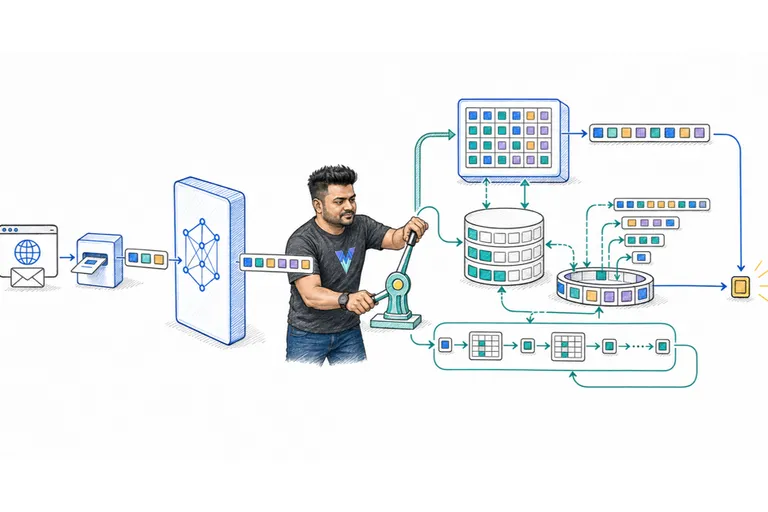
At every transformer layer, attention projects each token into key and value vectors. During autoregressive decoding, keys and values for prior tokens do not change, so recomputing them would waste most of the work. The KV cache retains those tensors and appends one position per generated token. Its size grows with layer count, hidden dimensions, sequence length, batch size, and element precision. For a large model serving many long conversations, cache memory can exceed the memory occupied by quantized weights.
Grouped-query and multi-query attention reduce cache size by sharing key-value heads across multiple query heads. This architectural choice can materially increase serving concurrency, but an operator cannot retrofit it into an arbitrary checkpoint without retraining or conversion tradeoffs. For an existing model, the controllable variables are context caps, cache precision, placement, and admission. Calculate bytes per token for the exact checkpoint and runtime rather than relying on model parameter count, which says almost nothing about key-value head geometry.
A sequence consumes cache before it returns revenue or user value. Prompts allocate pages during prefill, while output reserves are uncertain. If the allocator accepts more theoretical work than memory supports, the server will eventually evict, recompute, swap, or fail. Each fallback has a latency signature. Build a per-request cache estimate from input tokens plus an output reservation, expose it to admission control, and revise it during generation. Memory pressure should be an intentional policy signal, not a surprise CUDA allocation error.
Paged allocation prevents fragmentation
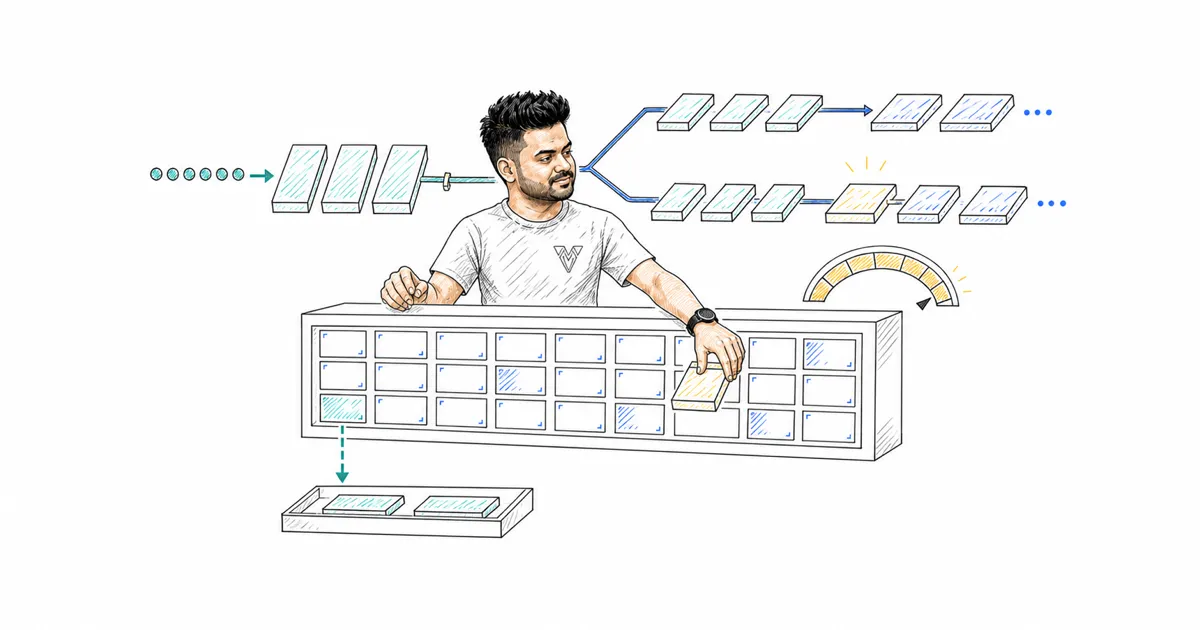
A naive cache allocates one contiguous maximum-length tensor for every sequence. Most requests finish early, so the reserved tail wastes memory, while variable lifetimes leave holes that are difficult to reuse. Paged attention divides cache storage into fixed-size blocks and maps each sequence’s logical token positions to physical blocks. New pages are allocated only when needed. The indirection resembles virtual memory and lets unrelated sequences occupy adjacent physical capacity without requiring contiguous growth.
Page size creates a three-way tradeoff. Large pages reduce page-table overhead and make memory access more regular, but waste the unused tail of short or completed sequences. Small pages improve packing and sharing granularity, while increasing metadata, allocator traffic, and attention-kernel complexity. Measure internal fragmentation under the real length distribution. The best page size for short support chats can differ from one for coding agents that maintain hours of history and routinely cross tens of thousands of tokens.
Reference counting allows multiple sequences to share immutable pages. Beam search, parallel sampling, and prompt caching all begin with identical prefixes, so copying their cache would multiply memory for no semantic benefit. Shared pages become copy-on-write when paths diverge. Correctness requires strict ownership rules: a reused page must never be mutated, and cancellation must decrement references exactly once. Allocator metrics should include free pages, pinned shared pages, allocation failures, and time spent waiting for a page.
Prefix caching is a content-addressed system
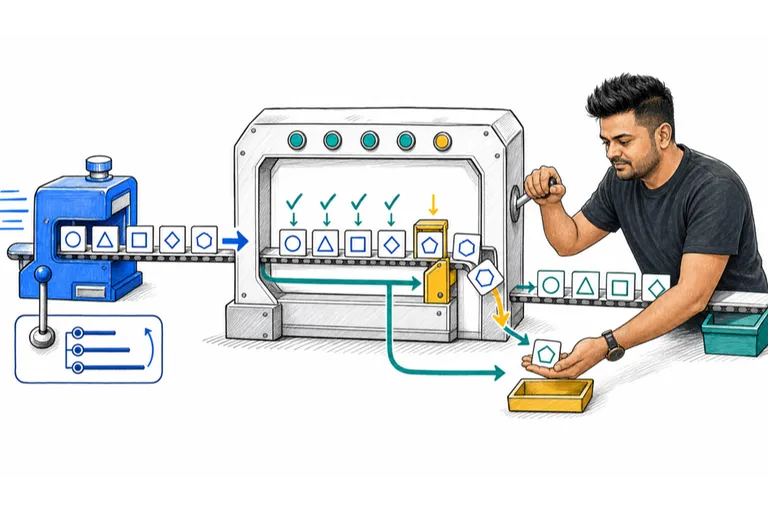
Many requests repeat a stable system prompt, tool schema, policy handbook, or document prefix. Prefix caching stores the resulting KV pages and attaches them to later requests, skipping repeated prefill computation. The cache key must cover every input that changes hidden states: exact token IDs, model and adapter identity, position encoding configuration, relevant runtime options, and sometimes multimodal preprocessing. Hashing raw strings is insufficient because tokenizer versions or message templates can produce different token streams.
Radix trees match prefixes incrementally and can reuse the longest available token path rather than requiring an all-or-nothing exact prompt. This works especially well when a tenant shares a system prompt and branches into many conversations. Ordering matters: placing stable instructions and reusable documents before volatile user content maximizes the common prefix. Yet prompt reordering can change model behavior, so reuse is an architecture consideration, not a free formatting trick. Validate quality before reorganizing context solely for cache efficiency.
Cached prefixes are both valuable and sensitive. They may contain proprietary instructions or retrieved customer data, so cache namespaces must enforce tenant and authorization boundaries. Encrypting device memory is uncommon, making process isolation and lifecycle controls important. Set TTLs, invalidate entries after model or policy changes, and avoid logging raw prefix material in cache diagnostics. A high hit rate is not automatically good if stale instructions survive a safety update or if cross-tenant reuse creates an information leak.
Eviction, offload, and compression
Least-recently-used eviction is simple but often wrong for active generation. A paused agent waiting for a tool may be inactive yet expensive to recompute, while a completed cached prefix can be cheaply rebuilt. Assign eviction value from recompute cost, expected reuse, tenant priority, and latency commitment. Pin currently decoding pages unless the alternative is failing the device. If an active sequence must be evicted, preserve enough scheduler and sampling state to resume deterministically rather than returning a subtly different continuation.
CPU offload trades scarce GPU memory for PCIe or interconnect latency. It works best for sequences with known idle periods, such as agents awaiting network tools, and poorly when every decode step needs the offloaded pages. Transfer whole page groups asynchronously and prefetch before the sequence becomes runnable. NVMe extends capacity further but belongs to a different latency tier. Model the cache as a hierarchy with explicit promotion rules, not an undifferentiated pool that moves data reactively under crisis.
Lower-precision cache formats can double capacity, but calibration should include long-context attention, exact retrieval, code completion, and repeated generation. Error impact is not uniform across layers or heads, so mixed precision may preserve sensitive components while compressing others. Watch quality alongside allocator health: cache hit rate, bytes per active token, offload bandwidth, recomputation tokens, and eviction-induced first-token latency. These metrics connect memory decisions to the user experience and prevent optimization from becoming a silent accuracy regression.
Research foundation and scope
Autoregressive attention reuses keys and values from prior positions; the retained tensors grow with layers, key-value heads, sequence length, concurrency, and precision. PagedAttention treats those allocations like virtual-memory blocks, and grouped-query attention reduces the number of key-value heads at the architecture level [VLLM] [GQA]. These sources establish the mechanism, but they do not remove the need to measure the local implementation. A paper's result belongs to its checkpoint, dataset, hardware, traffic, and experimental protocol; a standard describes a contract or risk practice, not a guarantee that a particular product follows it. The useful engineering move is to convert each cited idea into a hypothesis that can be falsified with representative inputs and observable intermediate state.
Parameter count does not reveal cache bytes per token. Operators must inspect the exact checkpoint geometry and runtime layout, then distinguish immutable reusable prefixes from private, mutable conversation state. Write these conditions into the design review before selecting a library or provider. Specify the authoritative source of truth, the authenticated principal, the versions that influence behavior, the maximum consequence of an error, and what the system will do when required evidence is missing. This boundary statement makes later optimization honest: teams can compare speed, cost, or convenience only after candidates satisfy the same correctness, authorization, privacy, and recovery contract.
Read [VLLM], [GQA], [FLASH] together rather than treating one source as a recipe. Efficient Memory Management for Large Language Model Serving with PagedAttention supplies one part of the foundation; GQA: Training Generalized Multi-Query Transformer Models from Multi-Head Checkpoints supplies a second perspective; FlashAttention: Fast and Memory-Efficient Exact Attention with IO-Awareness helps connect the mechanism to evaluation, governance, or operations. The citations are deliberately primary papers, standards, or official documentation. Product-specific claims still require local evidence, and any dated behavior must be rechecked against the cited version before an article or architecture decision is refreshed.
A production implementation blueprint
Calculate bytes per token, reserve pages at admission, allocate on demand, reference-count shared prefix blocks, and attach model, tokenizer, adapter, position, policy, and tenant identity to every cache key. Define copy-on-write and cancellation semantics explicitly. Begin with one thin vertical path that preserves all decision evidence. Give each run a stable identifier; capture normalized input, authenticated scope, relevant dependency versions, selected policy, timing, result status, and any external receipt. Keep large or sensitive payloads in a separately governed store and pass bounded references through the orchestration layer. This produces a debuggable system without making raw customer content the default telemetry substrate.
Make state transitions explicit and make every external boundary return a typed result. Distinguish validation failure, permission denial, missing evidence, rate limit, timeout, dependency outage, user cancellation, and internal defect. The distinction matters because each permits a different response: clarify, retry, fall back, defer, compensate, or stop. A generic exception handler that asks the model to try again turns uncertainty into repeated cost and can duplicate irreversible effects. Retries require an idempotency strategy and a stored receipt, not optimism.
Roll out the implementation as a versioned policy. Record which cohort receives it, what baseline it replaces, which metrics can stop the rollout, and how to reverse stateful artifacts such as indexes, caches, adapters, or workflow histories. Review privacy and retention alongside performance. If raw content is needed temporarily for diagnosis, state the purpose, access, sampling, encryption, and deletion window. Production readiness means the team can explain, contain, and reverse behavior under load—not merely demonstrate the happy path once.
Failure lab and evaluation plan
Run the real sequence-length distribution through candidate page sizes and measure internal fragmentation, allocator overhead, prefix-hit depth, and capacity. Separately evaluate lower-precision KV formats on long-context retrieval and code tasks. Keep the arrival pattern, data distribution, authorization, and dependency versions close to production. Use a paired baseline where possible and retain per-case results so averages cannot hide a severe slice. Offline evaluation should localize the failing stage; shadow evaluation should expose integration and traffic effects; a canary should confirm user-facing outcomes with a small blast radius. Each stage needs an exit criterion rather than a vague request to 'look good.'
Test stale prefix reuse after a policy change, a tokenizer upgrade, page-reference leaks after cancellation, cross-tenant key collision, offload thrashing, and an active sequence that cannot grow. Confirm that eviction preserves or explicitly ends deterministic generation state. Add adversarial boundary cases and partial failures, not only malformed inputs. Terminate a worker after an external system may have committed, revoke access after a cache was populated, change one dependency version, and delay one branch until its data is stale. Confirm that cancellation releases resources and that a fallback preserves semantics. The test passes only when the external outcome, audit evidence, and user-visible state agree; a fluent final message is not proof of completion.
Evaluation data needs lineage equal to production data. Record why each case exists, who reviewed the expected behavior, which source or policy supports it, and when it must be refreshed. Separate generated cases from production incidents and prevent test cases from leaking into training. When a metric changes, inspect changed examples before accepting an aggregate. A statistically small regression can still block release if it crosses an authorization, privacy, safety, or irreversible-action boundary.
Operating metrics and decision record
Track cache bytes per active token, free and pinned pages, allocation waits, reuse depth, recomputation tokens, offload traffic, eviction-induced latency, and quality deltas for compressed cache formats. Define every metric with a numerator, denominator, unit, time window, exclusions, and responsible owner. Segment by workload and consequence so a dominant easy class cannot hide a rare costly failure. Pair service signals with product outcomes: latency without completion encourages fast useless answers, while answer quality without queue and cost data can produce an uneconomic service. Review percentiles and distributions rather than relying on a single average.
Select page size, cache precision, reuse scope, and eviction value from measured packing and recomputation economics, never from maximum context length alone. Put that choice in a short architecture decision record containing context, alternatives, evidence, assumptions, selected policy, rollout, reversal trigger, and unresolved risk. Link the evaluation snapshot and source versions. This document prevents a benchmark from becoming folklore and tells the next engineer which evidence must be repeated when the model, provider, traffic, data, regulation, or product promise changes.
Monitor leading and lagging signals after release. Leading signals reveal pressure—queue age, cache allocation, disagreement, validation failure, policy denial, or retry growth—before users report harm. Lagging signals show whether the job was actually completed and trusted. Alert on a service objective tied to user consequence, and make the run identifier available to support without exposing private content. Every serious miss should become a reproducible regression case and, when relevant, a new threat or data-quality control.
Primary sources and further reading
- Efficient Memory Management for Large Language Model Serving with PagedAttentionOriginal research paper · paper
- GQA: Training Generalized Multi-Query Transformer Models from Multi-Head CheckpointsOriginal research paper · paper
- FlashAttention: Fast and Memory-Efficient Exact Attention with IO-AwarenessOriginal research paper · paper
Written by

Co-founder & CTO of ViitorCloud · Founder of LaraCopilot · Organizer of Laracon India · Shipping production software since 2005
More about Vishal