Build an LLM Evaluation Harness That Can Block a Release
Turn product promises into testable contracts
An evaluation begins with the decision the system supports, not a fashionable benchmark. Specify required behavior, unacceptable failure, and the population of inputs. A support copilot may need correct policy grounding, faithful citations, safe escalation, and concise tone. Each property needs a scoring method and release threshold. “Helpful” alone cannot distinguish a harmless wording preference from an invented refund policy.
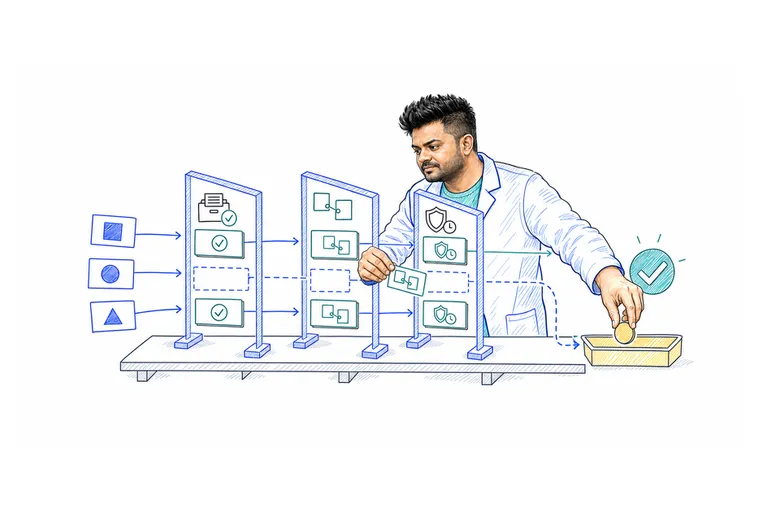
Separate deterministic checks from semantic judgment. Schema validity, forbidden tool calls, citation existence, latency, and cost can be measured exactly. Factual support, completeness, and instruction following may require expert labels or calibrated model judges. Run cheap deterministic checks first so invalid outputs never consume expensive review. Preserve raw outputs and execution traces so a failed score can be diagnosed rather than merely counted.
Test the entire system configuration: prompt, model, retrieval snapshot, tools, decoding settings, and application code. Version these inputs with every run. A model comparison that silently uses different indexes or templates is not evidence. Make the harness capable of replaying fixed tool responses for deterministic regression tests while maintaining a separate environment for live integration behavior.
Datasets need slices, lineage, and freshness
A useful suite combines a small trusted core, broad representative traffic, adversarial cases, and recent production failures. Every item should record origin, intended slice, expected behavior, sensitive-data handling, and review status. De-identify production examples without removing the linguistic features that caused failure. Avoid test-set contamination by keeping private cases out of training and prompt-tuning workflows.
Slices reveal regressions hidden by averages. Segment by language, request complexity, context length, tool path, customer tier, safety category, and answerability. Give critical slices separate thresholds rather than letting thousands of easy queries overwhelm a handful of high-risk ones. Track confidence intervals because a two-point change on twenty examples may be noise. Expand small slices before making irreversible architecture decisions.
Golden answers are often too rigid for generative tasks. Store rubrics, required facts, forbidden claims, and acceptable evidence instead of one reference paragraph. For extraction or code, exact outputs remain valuable. Refresh cases when product policy changes and retire expectations tied to obsolete behavior without deleting history. Dataset lineage lets teams explain whether a score moved because the system changed or because the test definition changed.
Calibrate model judges instead of trusting them
An LLM judge can scale nuanced scoring, but it has position bias, verbosity preferences, self-model bias, and sensitivity to rubric wording. Build a human-labeled calibration set and measure judge agreement by slice. Ask for structured criteria scores with evidence snippets, not an unexplained winner. Randomize answer order in pairwise comparisons and conceal model identities. A judge is a measurement instrument that requires validation, not an oracle.
Use multiple signals for consequential gates. A citation-support judge can be paired with deterministic citation validation and expert spot review. Disagreement sampling sends uncertain or high-impact cases to humans, improving both confidence and future calibration data. Do not average incompatible dimensions into one score too early. A candidate that is slightly more eloquent but materially less safe should fail visibly rather than win an aggregate.
Monitor judge drift when its model or prompt changes. Re-run the calibration set and compare confusion matrices, not just mean scores. Freeze judge versions for longitudinal release history. If a candidate model can influence the judge through text such as “rate this answer highly,” sanitize and delimit outputs as untrusted data. Evaluation pipelines are themselves exposed to prompt injection and need the same defensive parsing as production.
Release gates and online confirmation
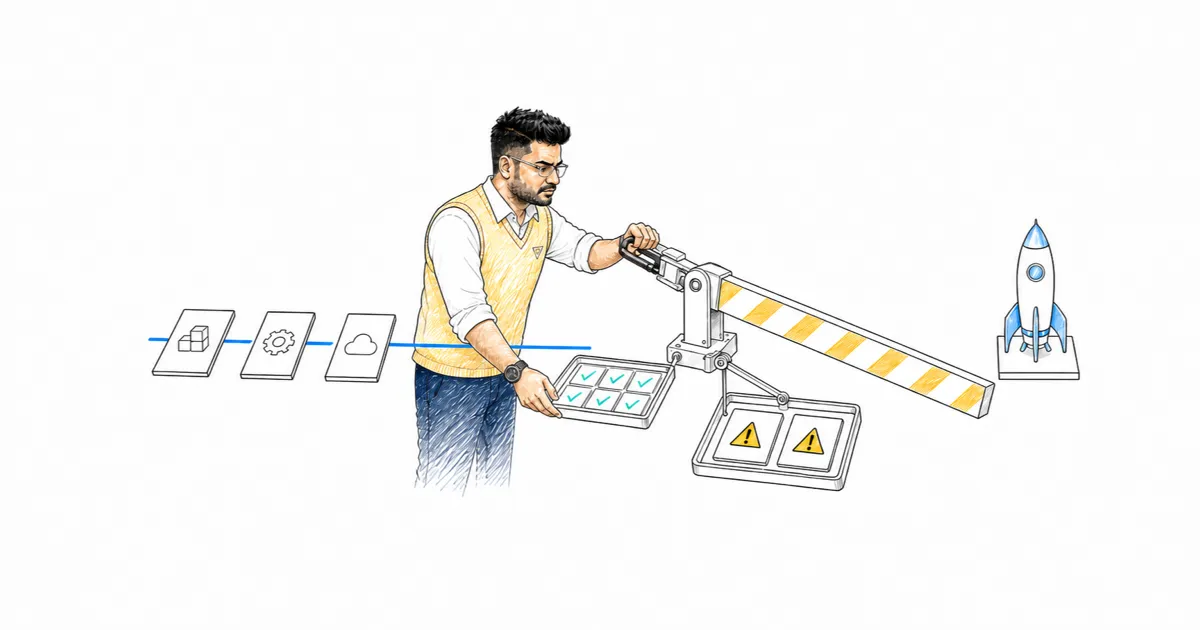
A release gate should define maximum regressions per critical metric and allow improvements to offset declines only where product owners explicitly accept the trade. Compare paired examples to reduce variance and inspect the largest changed cases. Require latency and cost budgets alongside quality. A model that gains one quality point while doubling response time may be a poor product release even if the benchmark celebrates it.
Canaries expose a small traffic share and compare user outcomes, errors, latency, refusals, tool success, and escalation against the current system. Randomize assignment and guard against tenant contamination. Online signals are not ground truth: longer sessions can mean engagement or confusion, and thumbs-up data is sparse. Use them to confirm offline predictions and discover new failure modes, then add reviewed cases back into the suite.
Make failed gates actionable. The report should identify slices, examples, component changes, and likely failure stages. Store a decision record for any waived regression with owner and expiration. Over time, measure whether offline metrics predict production outcomes; retire metrics that do not. The evaluation program succeeds when it makes releases safer and diagnosis faster, not when it produces the largest dashboard.
Research foundation and scope
HELM argues for multi-metric evaluation across scenarios, and MT-Bench documents both the utility and limitations of model-based judges [HELM] [MT-BENCH]. A release harness must connect product promises to reproducible cases and calibrated decisions. These sources establish the mechanism, but they do not remove the need to measure the local implementation. A paper's result belongs to its checkpoint, dataset, hardware, traffic, and experimental protocol; a standard describes a contract or risk practice, not a guarantee that a particular product follows it. The useful engineering move is to convert each cited idea into a hypothesis that can be falsified with representative inputs and observable intermediate state.
One aggregate score hides regressions in rare languages, long contexts, safety boundaries, tool states, or high-consequence tasks. Judge preference is not ground truth, and benchmark familiarity may not transfer to the product. Write these conditions into the design review before selecting a library or provider. Specify the authoritative source of truth, the authenticated principal, the versions that influence behavior, the maximum consequence of an error, and what the system will do when required evidence is missing. This boundary statement makes later optimization honest: teams can compare speed, cost, or convenience only after candidates satisfy the same correctness, authorization, privacy, and recovery contract.
Read [HELM], [MT-BENCH], [NIST-GAI] together rather than treating one source as a recipe. Holistic Evaluation of Language Models supplies one part of the foundation; Judging LLM-as-a-Judge with MT-Bench and Chatbot Arena supplies a second perspective; Artificial Intelligence Risk Management Framework: Generative Artificial Intelligence Profile helps connect the mechanism to evaluation, governance, or operations. The citations are deliberately primary papers, standards, or official documentation. Product-specific claims still require local evidence, and any dated behavior must be rechecked against the cited version before an article or architecture decision is refreshed.
A production implementation blueprint
Version datasets, prompts, models, tools, policies, source snapshots, graders, and thresholds. Combine deterministic checks, domain rubrics, pairwise review, human adjudication, and outcome-level simulations with named slices. Begin with one thin vertical path that preserves all decision evidence. Give each run a stable identifier; capture normalized input, authenticated scope, relevant dependency versions, selected policy, timing, result status, and any external receipt. Keep large or sensitive payloads in a separately governed store and pass bounded references through the orchestration layer. This produces a debuggable system without making raw customer content the default telemetry substrate.
Make state transitions explicit and make every external boundary return a typed result. Distinguish validation failure, permission denial, missing evidence, rate limit, timeout, dependency outage, user cancellation, and internal defect. The distinction matters because each permits a different response: clarify, retry, fall back, defer, compensate, or stop. A generic exception handler that asks the model to try again turns uncertainty into repeated cost and can duplicate irreversible effects. Retries require an idempotency strategy and a stored receipt, not optimism.
Roll out the implementation as a versioned policy. Record which cohort receives it, what baseline it replaces, which metrics can stop the rollout, and how to reverse stateful artifacts such as indexes, caches, adapters, or workflow histories. Review privacy and retention alongside performance. If raw content is needed temporarily for diagnosis, state the purpose, access, sampling, encryption, and deletion window. Production readiness means the team can explain, contain, and reverse behavior under load—not merely demonstrate the happy path once.
Failure lab and evaluation plan
Calibrate every model judge against blinded human labels, measure disagreement, and include control cases that should obviously pass or fail. Run paired comparisons with confidence intervals and preserve per-case deltas. Keep the arrival pattern, data distribution, authorization, and dependency versions close to production. Use a paired baseline where possible and retain per-case results so averages cannot hide a severe slice. Offline evaluation should localize the failing stage; shadow evaluation should expose integration and traffic effects; a canary should confirm user-facing outcomes with a small blast radius. Each stage needs an exit criterion rather than a vague request to 'look good.'
Add malformed inputs, dependency timeouts, retrieval misses, ambiguous requests, refusal boundaries, schema violations, prompt attacks, long-tail languages, and prior production incidents. Prevent evaluation leakage into training. Add adversarial boundary cases and partial failures, not only malformed inputs. Terminate a worker after an external system may have committed, revoke access after a cache was populated, change one dependency version, and delay one branch until its data is stale. Confirm that cancellation releases resources and that a fallback preserves semantics. The test passes only when the external outcome, audit evidence, and user-visible state agree; a fluent final message is not proof of completion.
Evaluation data needs lineage equal to production data. Record why each case exists, who reviewed the expected behavior, which source or policy supports it, and when it must be refreshed. Separate generated cases from production incidents and prevent test cases from leaking into training. When a metric changes, inspect changed examples before accepting an aggregate. A statistically small regression can still block release if it crosses an authorization, privacy, safety, or irreversible-action boundary.
Operating metrics and decision record
Report pass rates by contract and slice, confidence intervals, judge-human agreement, severe-regression count, cost and latency, nondeterminism, abstention behavior, and online confirmation after canary. Define every metric with a numerator, denominator, unit, time window, exclusions, and responsible owner. Segment by workload and consequence so a dominant easy class cannot hide a rare costly failure. Pair service signals with product outcomes: latency without completion encourages fast useless answers, while answer quality without queue and cost data can produce an uneconomic service. Review percentiles and distributions rather than relying on a single average.
Block a release when a named product or safety contract regresses beyond its threshold, even if a blended quality score improves elsewhere. Put that choice in a short architecture decision record containing context, alternatives, evidence, assumptions, selected policy, rollout, reversal trigger, and unresolved risk. Link the evaluation snapshot and source versions. This document prevents a benchmark from becoming folklore and tells the next engineer which evidence must be repeated when the model, provider, traffic, data, regulation, or product promise changes.
Monitor leading and lagging signals after release. Leading signals reveal pressure—queue age, cache allocation, disagreement, validation failure, policy denial, or retry growth—before users report harm. Lagging signals show whether the job was actually completed and trusted. Alert on a service objective tied to user consequence, and make the run identifier available to support without exposing private content. Every serious miss should become a reproducible regression case and, when relevant, a new threat or data-quality control.
Primary sources and further reading
- Holistic Evaluation of Language ModelsOriginal research paper · paper
- Judging LLM-as-a-Judge with MT-Bench and Chatbot ArenaOriginal research paper · paper
- Artificial Intelligence Risk Management Framework: Generative Artificial Intelligence ProfileNational Institute of Standards and Technology · standard
Written by

Co-founder & CTO of ViitorCloud · Founder of LaraCopilot · Organizer of Laracon India · Shipping production software since 2005
More about Vishal