Agents That Finish
Engineering long-horizon reliability into software that runs without you
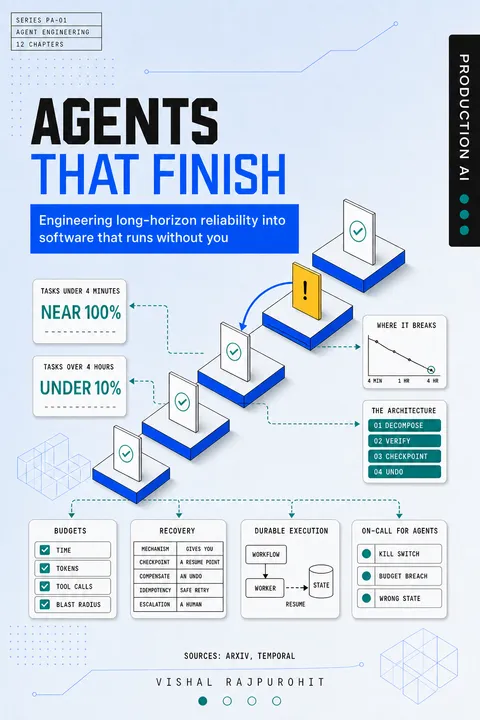
Agent reliability is an architecture, not a model property: systems complete multi-hour work because they can decompose it, verify each step, checkpoint state and undo a wrong commitment.
Frontier models are close to perfect on work a skilled person would finish in four minutes and close to useless on work that takes four hours. The gap is not intelligence. It is that most agent architectures cannot notice a wrong intermediate state, let alone roll one back, so the first bad commitment is inherited by every step after it. This book builds outwards from that failure mode: decomposition as a real artifact, verification between steps, checkpoints an agent can resume from, compensating actions for effects that already left the system, and budgets that bound the damage when none of it works.
Written for: Engineers and architects putting an agent in front of work that outlives a single request.
No chapter is published yet. The full contents below is the finished outline; chapters go live as they are written, and none of them will sit behind a signup.
What it makes operable
Outcomes, not topic coverage.
- 01Instrument the step where your agent's first wrong commitment happens
- 02Design checkpoints and compensating actions an agent can genuinely recover through
- 03Place verification gates between steps instead of trusting the final answer
- 04Measure a reliability horizon for your own workload rather than a benchmark's
Complete contents
12 chapters, in order.
Each chapter settles one decision, so it can be read on its own. Read in sequence to build the argument the book is making.
- 01In writing
The Four-Minute Agent and the Four-Hour Task
Where the reliability horizon actually sits, and why capability scores hide it.
- 02In writing
Why Failures Compound: The No-Recovery Bottleneck
One wrong intermediate state, inherited by every step that follows it.
- 03In writing
Decomposition as an Engineering Artifact, Not a Prompt
Writing the plan as a structure the runtime can check, resume and revise.
- 04In writing
Checkpoints: What an Agent Must Be Able to Resume From
Choosing the state boundary that makes a restart cheap and a rollback possible.
- 05In writing
Verification Gates Between Steps
Cheap per-step checks that catch a wrong commitment before it propagates.
- 06In writing
Compensating Actions and Safe Undo
Reversing effects that already left your system, and admitting when you cannot.
- 07In writing
Durable Execution: Workflows, Retries, Idempotency
Where agent state lives when the process running it dies mid-task.
- 08In writing
Tools Are the Real Interface
Designing an API for a caller that will sometimes get the arguments wrong.
- 09In writing
Budgets: Time, Tokens, Tool Calls, Blast Radius
Four ceilings that turn an open-ended loop into a bounded operation.
- 10In writing
Handing Control Back to a Human
Escalation as a designed path, carrying enough context to be actionable.
- 11In writing
Measuring a Reliability Horizon for Your Own Workload
Building the curve for your tasks instead of inheriting someone else's benchmark.
- 12In writing
On-Call for Agents
Alerts, kill switches and the runbook for software that acts on its own.
Evidence
What this book is arguing against.
Third-party sources behind the book's premise. Every figure in them belongs to the party that published it and is attributed to them in the text.
- The Long-Horizon Task Mirage? Diagnosing Where and Why Agentic Systems Break
arXiv · 2026-04-13 · Research paper · reported
- Beyond pass@1: A Reliability Science Framework for Long-Horizon LLM Agents
arXiv · 2026-03-31 · Research paper · reported
- Temporal Docs
Temporal · Official documentation · verified
Continue through the library
Adjacent operating manuals.
Engineering the Context Window
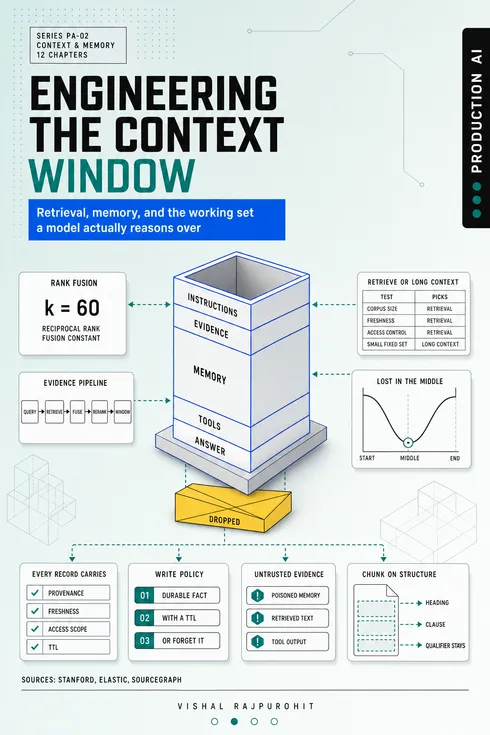
Retrieval, memory, compaction and ordering are usually built by different people at different times, and then the result is judged as though the model were the variable. This book treats them as a single system for deciding what the model sees: an evidence pipeline feeding a budgeted, ordered window, with provenance, freshness and access control surviving all the way into the prompt. It also takes the long-context argument seriously — long windows did kill lazy retrieval — and gives you the tests that show which parts of your own pipeline are now redundant.
Read the full book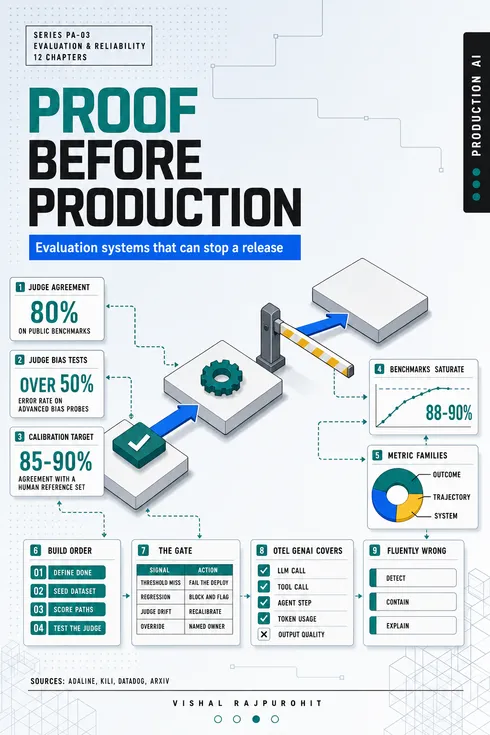
Proof Before Production
The demo passes because someone chose the inputs. The product fails quietly because production did not. This book builds the apparatus that closes the gap: a definition of done for open-ended output, a first dataset drawn from real traffic, metrics separated into outcome, trajectory and system, a judge calibrated against human annotation that carries its own error bar, and a suite with the authority to fail a deploy. It also draws the line where the OpenTelemetry GenAI conventions stop and your own evaluation data has to start.
Read the full book