Shipping With Agents
Running an engineering organisation when machines write most of the code
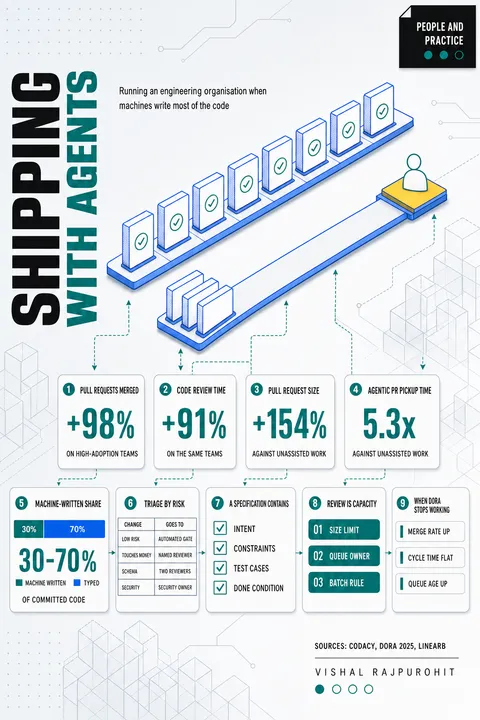
When authorship stops being the constraint, specification and review become it, and an organisation that keeps its old review, ownership and measurement model just converts a coding bottleneck into a queue.
Merge rate goes up, cycle time does not move, and everyone blames the tooling. The tooling is fine; the operating model is not. This book redesigns the functions that authorship used to absorb: what a specification has to contain now, how to triage review by risk, what PR size and queue discipline actually buy, who owns code nobody typed, how tests become the contract with the agent, and which delivery metrics still mean anything once most committed code is machine-written.
Written for: CTOs, VPs and team leads whose merge rate went up and whose cycle time did not.
No chapter is published yet. The full contents below is the finished outline; chapters go live as they are written, and none of them will sit behind a signup.
What it makes operable
Outcomes, not topic coverage.
- 01Redesign review as scarce capacity, with triage, size limits and a named owner per queue
- 02Write specifications and tests that hold an agent to a contract
- 03Measure delivery when most committed code was not typed by a person
- 04Keep ownership and craft intact as adoption increases
Complete contents
12 chapters, in order.
Each chapter settles one decision, so it can be read on its own. Read in sequence to build the argument the book is making.
- 01In writing
The Bottleneck Moved
More merged pull requests, the same cycle time, and where the hours went.
- 02In writing
What a Specification Has to Contain Now
Writing intent precisely enough that a machine can implement it.
- 03In writing
Review as the Scarce Resource
Treating reviewer attention as capacity to be planned, not goodwill to be spent.
- 04In writing
Automated First-Pass Gates and Risk-Based Triage
Moving baseline correctness off people, and routing low-risk change around them.
- 05In writing
PR Size, Batching, and Queue Discipline
Limits and batching rules that stop the queue from becoming the product.
- 06In writing
Ownership When Nobody Typed the Code
Accountability, on-call and code ownership for generated change.
- 07In writing
Tests as the Contract With the Agent
The suite as the specification an agent is actually held to.
- 08In writing
Measuring Delivery When DORA Stops Working
Which metrics survive, which mislead, and what has to be added.
- 09In writing
Juniors, Craft, and Not Deskilling the Team
Building judgement in people who never had to write the easy version.
- 10In writing
Tooling Budgets and Where the Money Actually Goes
Seats, tokens, compute and review hours, costed against delivered change.
- 11In writing
Security and Compliance Inside the Loop
Putting controls where the agent works instead of downstream of it.
- 12In writing
Adopting This Without Breaking the Team
A sequence of changes engineers will not have to resist.
Evidence
What this book is arguing against.
Third-party sources behind the book's premise. Every figure in them belongs to the party that published it and is attributed to them in the text.
- AI Is Breaking Code Review: How Engineering Teams Fix the PR Bottleneck
Codacy · 2026-07-22 · Industry report · reported
- Key Takeaways from the DORA Report 2025: How AI is Reshaping Software Development Metrics and Team Performance
Faros AI · 2025-09-25 · Industry report · reported
- Spec-Driven Development (SDD): The Definitive 2026 Guide
BCMS · 2026-05-11 · Industry report · reported
Continue through the library
Adjacent operating manuals.
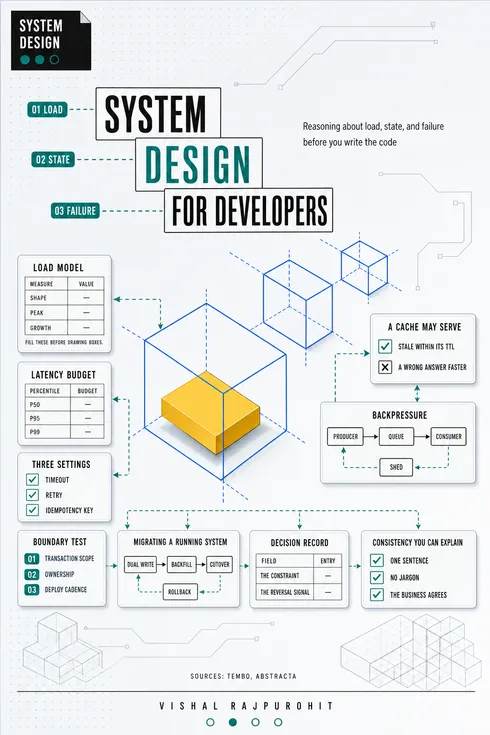
System Design for Developers
Design is not drawing boxes. It is deciding, in order, what load the system has to absorb, where state lives and what consistency it needs, and how the thing behaves when a dependency is gone — then recording the constraint that forced each answer and the signal that would reverse it. This book works through that order using the decisions that actually cost money later: data model, service boundaries, caching, queues and backpressure, timeouts and idempotency, observability, capacity, and how to migrate a system that cannot stop running.
Read the full book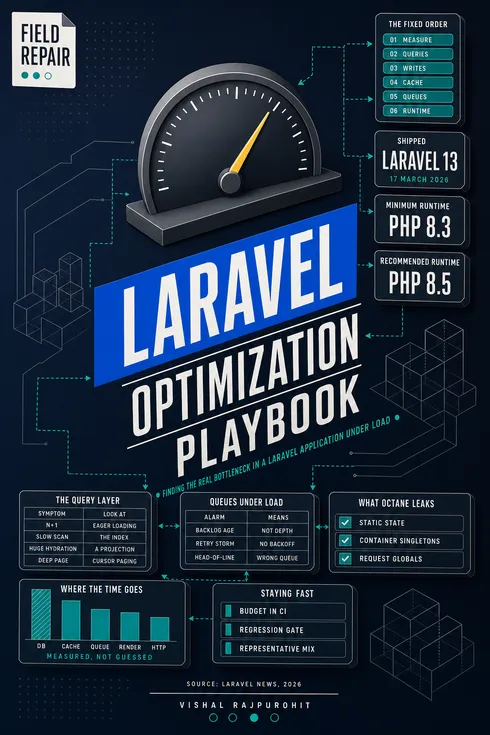
Laravel Optimization Playbook
An application that got slower as it got busier does not need a new framework. It needs to be measured, then worked through in a fixed order: the query layer, then write contention, then cache invalidation, then queue saturation, then the runtime. This book runs that order with a measurement at every stage, and ends with the budgets and regression gates that stop the win from decaying the week after you ship it.
Read the full book