Edge LLM Inference: Designing for the Device
Start from the device envelope
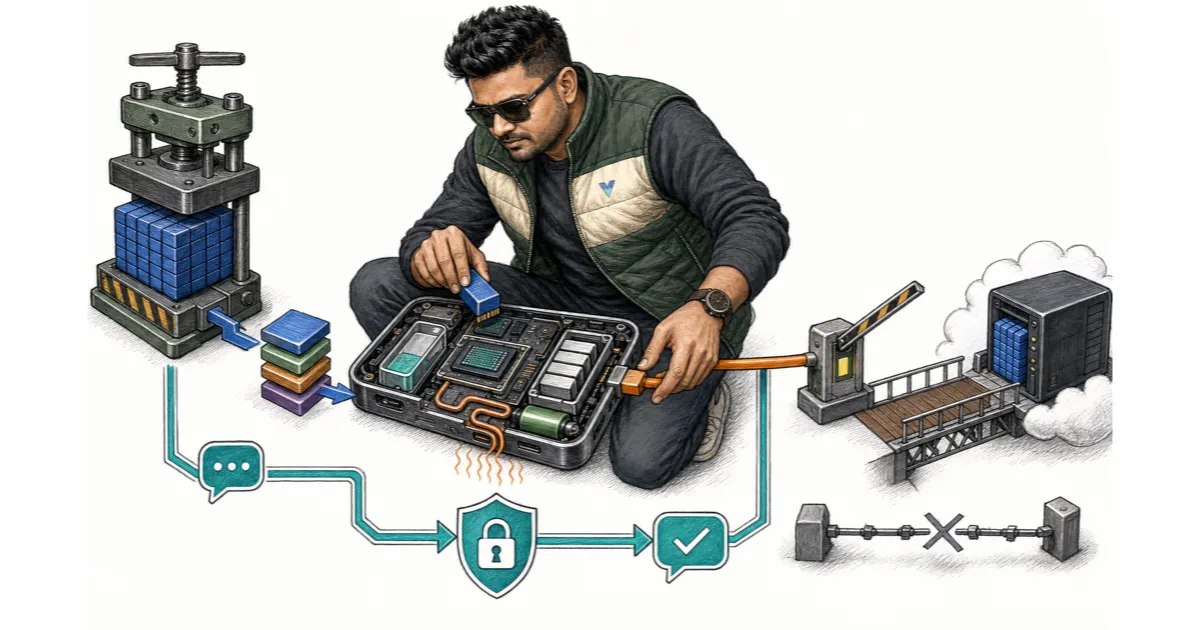
An edge deployment is constrained by memory, bandwidth, compute units, battery, thermals, storage, and operating-system lifecycle. Peak benchmark speed matters less than sustained performance after the device warms. Define target hardware classes and a service objective for first token, generation rate, energy, and maximum memory pressure. A model that runs on a developer flagship but is killed on a two-year-old phone is not an on-device product.
Weights are only part of memory. Account for runtime buffers, KV cache growth, tokenization, application assets, and other processes. Mobile operating systems can reclaim memory aggressively, so leave headroom and test background-foreground transitions. Context limits may need to vary by device. Use explicit admission and truncation policies rather than allowing allocation failure halfway through generation.
Hardware acceleration APIs differ in supported operators, precision, dynamic shapes, and compilation behavior. Choose a runtime that targets the relevant neural engine, GPU, or CPU and confirm the model graph avoids expensive fallbacks. Measure end-to-end inside the application, including model load and tokenization. A fast kernel does not help if graph compilation blocks the first interaction for twenty seconds.
Quantize against task quality
Four-bit weights can reduce storage and memory bandwidth substantially, but format, group size, scale precision, and outlier treatment determine accuracy and speed. A format optimized for desktop CPU may not map efficiently to a phone accelerator. Test kernels on target devices before selecting the checkpoint. Smaller file size does not guarantee faster inference if dequantization falls back to slow operations.
Calibration data should resemble the product’s languages, prompts, and output structures. Measure exact task outcomes, not only general perplexity. Quantization may disproportionately damage rare tokens, code syntax, multilingual text, or tool argument precision. Mixed-precision strategies keep sensitive layers or embeddings at higher precision while compressing most weights. Selective choices often beat forcing one bit width across the graph.
KV-cache precision and context length are additional levers. Compressing cache may enable longer conversations, but quality can degrade as errors accumulate. Sliding windows, retrieval, and structured memory can keep useful history without retaining every token. Benchmark multi-turn behavior at the maximum supported context and after thermal throttling. Edge quality is the joint result of model, numeric format, runtime, and memory policy.
Build hybrid execution deliberately
On-device models provide privacy, offline availability, and low network latency, while cloud models offer greater capability and current centralized knowledge. A hybrid router can keep classification, drafting, and private transformations local, escalating complex tasks with explicit consent. Define what data may leave the device and minimize it before transfer. An automatic fallback that uploads the full conversation can violate the privacy reason users chose the feature.
Confidence for escalation should use validation and task signals, not the local model’s self-assessment alone. Structured extraction can be checked against schema and source; generation may use uncertainty, length, or unsupported capability signals. The user experience should explain when cloud processing is required, its benefit, and what is sent. Cache consent according to policy without turning one approval into permanent unrestricted transfer.
Handle offline and flaky connectivity as normal states. Queue only operations safe to delay, expire stale requests, and avoid duplicate cloud actions after reconnect. Version local and cloud prompts and schemas together so handoff state is compatible. If a cloud response returns after the user changed the underlying document, validate its source version before applying it.
Ship models like application dependencies
Model downloads require signing, integrity hashes, resumable transfer, storage quotas, and rollback. Use staged rollout by device class and monitor crash, load, latency, thermal, and battery signals. Delta updates can reduce bandwidth but complicate verification. Keep a known-good model available until the new version passes real-device canaries. Never execute an unverified artifact fetched from a mutable URL.
Consider whether the model ships with the app or downloads after install. Bundling increases package size and release coupling; downloading delays first use and needs network and storage UX. Prewarm only when it does not harm startup or battery. Give users visibility and control over large downloads, especially on metered networks. Remove obsolete versions after successful activation while preserving rollback policy.
Evaluation farms should include representative operating-system versions, memory tiers, chip generations, battery states, and thermal conditions. Automate product tasks rather than isolated token loops. Feed crash and quality regressions into release gates. Edge inference succeeds when it is quiet infrastructure: available when needed, private by design, predictable under constraint, and updateable without destabilizing the device.
Research foundation and scope
On-device inference trades datacenter elasticity for bounded memory, thermal, battery, and accelerator support. MLPerf Mobile supplies repeatable mobile benchmarks, while MLX illustrates an array framework designed around Apple silicon's unified memory [MLPERF-MOBILE] [MLX]. These sources establish the mechanism, but they do not remove the need to measure the local implementation. A paper's result belongs to its checkpoint, dataset, hardware, traffic, and experimental protocol; a standard describes a contract or risk practice, not a guarantee that a particular product follows it. The useful engineering move is to convert each cited idea into a hypothesis that can be falsified with representative inputs and observable intermediate state.
A model that loads once is not production-ready. Device generation, available memory, OS pressure, sustained thermals, battery state, accelerator operators, context length, and app coexistence determine usable performance. Write these conditions into the design review before selecting a library or provider. Specify the authoritative source of truth, the authenticated principal, the versions that influence behavior, the maximum consequence of an error, and what the system will do when required evidence is missing. This boundary statement makes later optimization honest: teams can compare speed, cost, or convenience only after candidates satisfy the same correctness, authorization, privacy, and recovery contract.
Read [MLPERF-MOBILE], [MLX], [NIST-GAI] together rather than treating one source as a recipe. MLPerf Mobile benchmark supplies one part of the foundation; MLX: An Array Framework for Apple Silicon supplies a second perspective; Artificial Intelligence Risk Management Framework: Generative Artificial Intelligence Profile helps connect the mechanism to evaluation, governance, or operations. The citations are deliberately primary papers, standards, or official documentation. Product-specific claims still require local evidence, and any dated behavior must be rechecked against the cited version before an article or architecture decision is refreshed.
A production implementation blueprint
Define a device support matrix, select architecture and quantization from task quality, package signed model artifacts, verify integrity, bound context and output, and design an explicit cloud fallback with consent and equivalent semantics. Begin with one thin vertical path that preserves all decision evidence. Give each run a stable identifier; capture normalized input, authenticated scope, relevant dependency versions, selected policy, timing, result status, and any external receipt. Keep large or sensitive payloads in a separately governed store and pass bounded references through the orchestration layer. This produces a debuggable system without making raw customer content the default telemetry substrate.
Make state transitions explicit and make every external boundary return a typed result. Distinguish validation failure, permission denial, missing evidence, rate limit, timeout, dependency outage, user cancellation, and internal defect. The distinction matters because each permits a different response: clarify, retry, fall back, defer, compensate, or stop. A generic exception handler that asks the model to try again turns uncertainty into repeated cost and can duplicate irreversible effects. Retries require an idempotency strategy and a stored receipt, not optimism.
Roll out the implementation as a versioned policy. Record which cohort receives it, what baseline it replaces, which metrics can stop the rollout, and how to reverse stateful artifacts such as indexes, caches, adapters, or workflow histories. Review privacy and retention alongside performance. If raw content is needed temporarily for diagnosis, state the purpose, access, sampling, encryption, and deletion window. Production readiness means the team can explain, contain, and reverse behavior under load—not merely demonstrate the happy path once.
Failure lab and evaluation plan
Benchmark cold and warm starts, sustained multi-turn use, background and foreground transitions, low battery, memory pressure, representative devices, and airplane mode. Compare quantization against task-level outcomes, not only perplexity. Keep the arrival pattern, data distribution, authorization, and dependency versions close to production. Use a paired baseline where possible and retain per-case results so averages cannot hide a severe slice. Offline evaluation should localize the failing stage; shadow evaluation should expose integration and traffic effects; a canary should confirm user-facing outcomes with a small blast radius. Each stage needs an exit criterion rather than a vague request to 'look good.'
Test unsupported operators, model download interruption, corrupted artifact, storage exhaustion, thermal throttling, OS eviction, device clock error, revoked model, privacy-sensitive fallback, and an update that cannot roll back. Add adversarial boundary cases and partial failures, not only malformed inputs. Terminate a worker after an external system may have committed, revoke access after a cache was populated, change one dependency version, and delay one branch until its data is stale. Confirm that cancellation releases resources and that a fallback preserves semantics. The test passes only when the external outcome, audit evidence, and user-visible state agree; a fluent final message is not proof of completion.
Evaluation data needs lineage equal to production data. Record why each case exists, who reviewed the expected behavior, which source or policy supports it, and when it must be refreshed. Separate generated cases from production incidents and prevent test cases from leaking into training. When a metric changes, inspect changed examples before accepting an aggregate. A statistically small regression can still block release if it crosses an authorization, privacy, safety, or irreversible-action boundary.
Operating metrics and decision record
Use time to first token, sustained token rate, peak and steady memory, energy per completed task, temperature, crash and eviction rate, artifact size, model-update success, fallback rate, and task quality by device tier. Define every metric with a numerator, denominator, unit, time window, exclusions, and responsible owner. Segment by workload and consequence so a dominant easy class cannot hide a rare costly failure. Pair service signals with product outcomes: latency without completion encourages fast useless answers, while answer quality without queue and cost data can produce an uneconomic service. Review percentiles and distributions rather than relying on a single average.
Ship the smallest model and runtime that meet the task contract across the supported device envelope, with transparent fallback when the envelope is exceeded. Put that choice in a short architecture decision record containing context, alternatives, evidence, assumptions, selected policy, rollout, reversal trigger, and unresolved risk. Link the evaluation snapshot and source versions. This document prevents a benchmark from becoming folklore and tells the next engineer which evidence must be repeated when the model, provider, traffic, data, regulation, or product promise changes.
Monitor leading and lagging signals after release. Leading signals reveal pressure—queue age, cache allocation, disagreement, validation failure, policy denial, or retry growth—before users report harm. Lagging signals show whether the job was actually completed and trusted. Alert on a service objective tied to user consequence, and make the run identifier available to support without exposing private content. Every serious miss should become a reproducible regression case and, when relevant, a new threat or data-quality control.
Primary sources and further reading
- MLPerf Mobile benchmarkMLCommons · standard
- MLX: An Array Framework for Apple SiliconOriginal research paper · paper
- Artificial Intelligence Risk Management Framework: Generative Artificial Intelligence ProfileNational Institute of Standards and Technology · standard
Written by

Co-founder & CTO of ViitorCloud · Founder of LaraCopilot · Organizer of Laracon India · Shipping production software since 2005
More about Vishal