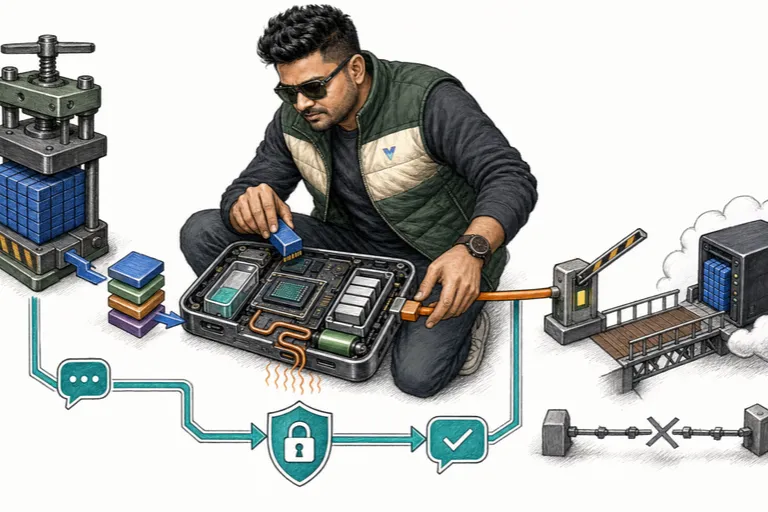
Multimodal AI Pipelines for Images, Audio, and Documents
The model begins after a media pipeline
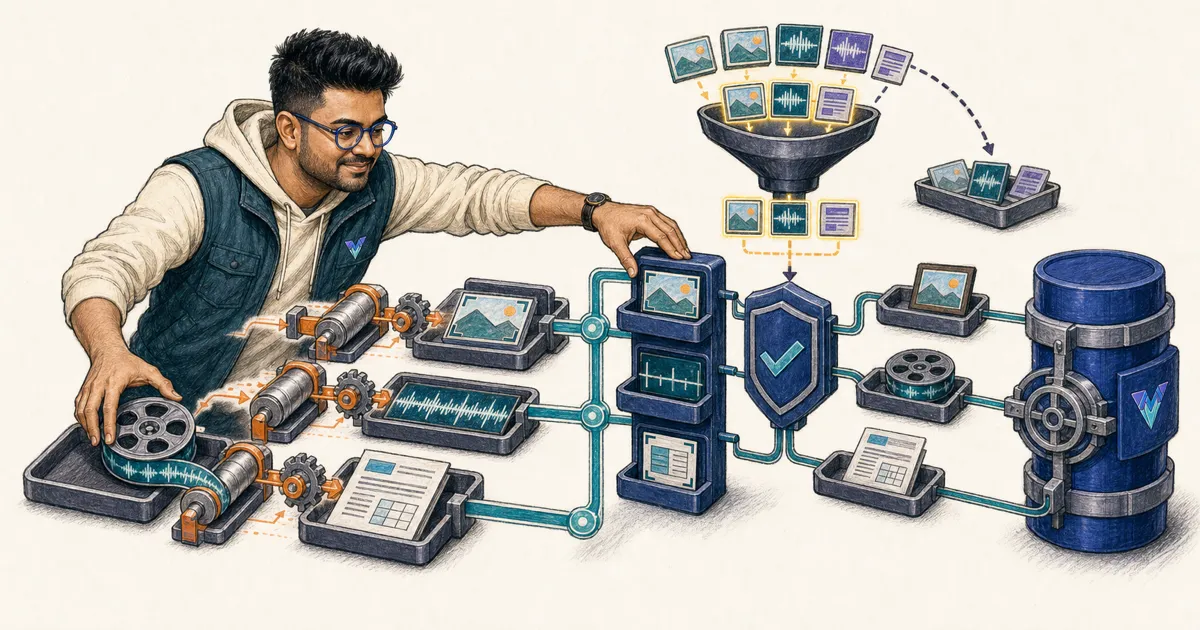
Images arrive with orientation metadata, color profiles, transparency, extreme dimensions, and possible corruption. Audio arrives with codecs, channels, sample rates, silence, and hours of duration. Documents mix text, raster pages, forms, tables, handwriting, and embedded files. Normalize these inputs deterministically, record every transformation, and preserve the original under a content hash. Model quality cannot compensate for a page rotated incorrectly or audio resampled into distortion.
Enforce limits before decoding media because compressed files can expand dramatically. Validate MIME type from bytes rather than trusting an extension, scan untrusted uploads, cap pixels and duration, and isolate parsers. Strip unnecessary metadata that may contain location or personal information. For remote media, fetch through an egress-controlled service with size and redirect limits. Multimodal ingestion expands both security and cost attack surfaces.
Create a manifest connecting original assets, derived frames, OCR blocks, audio segments, thumbnails, and model versions. This provenance lets an answer cite page regions or timestamps and enables reprocessing after a better parser. Avoid overwriting derived artifacts in place; immutable generations make evaluation reproducible. Retention policies should delete originals and derivatives consistently rather than leaving a forgotten thumbnail or transcript after the source is removed.
Budget visual and temporal tokens
A vision model converts images or tiles into tokens, so resolution and crop strategy directly affect cost and detail. A full high-resolution page may preserve small text but consume context on margins and decoration. Detect regions, use low-resolution overview plus targeted high-resolution crops, and pass coordinate metadata. For charts or diagrams, retain the global layout because isolated crops can lose relationships among labels, axes, and marks.
Video requires temporal sampling. Uniform frames miss short events; scene-change detection and motion-aware sampling cover transitions more effectively. Audio can guide selection by locating speech or impacts. Keep timestamps through every stage so the model’s claims can map back to playable evidence. For long recordings, hierarchical processing—segment summaries followed by query-focused retrieval—usually beats placing every frame and transcript token in one context.
Document understanding benefits from combining native text extraction, layout coordinates, and page images. OCR alone can scramble columns; native text alone omits visual grouping and scanned pages. Represent blocks with page, bounding box, reading order, and type, then retrieve relevant regions. The generation model should see enough surrounding layout to interpret a cell or footnote without consuming the entire document.
Ground outputs in space and time
Free-form descriptions are difficult to verify. Ask the model for structured observations tied to frame IDs, timestamps, page numbers, or bounding boxes. Validate that coordinates lie within the referenced asset and that timestamps exist. For object detection or measurement, prefer specialized models and deterministic geometry where they are more accurate. A general multimodal model can orchestrate and explain without owning every perception task.
OCR and transcription carry uncertainty. Retain token or segment confidence and avoid turning low-confidence text into an authoritative claim. Cross-check critical identifiers with alternative decoders or domain rules, such as invoice formats and checksum digits. Let users inspect the source crop or play the cited audio segment. Visibility of evidence is especially important because a fluent description can conceal a tiny but consequential perception error.
When the model produces an edited image, annotation, or extracted form, verify invariants specific to the workflow. An identity document parser checks field consistency; a product inspection checks required views; a localization pipeline checks text and layout. Generic similarity metrics rarely capture these contracts. Human review should focus on low-confidence or high-impact outputs, supported by the exact source region and transformation history.
Evaluate across media conditions
Build slices for resolution, blur, glare, rotation, handwriting, accents, background noise, overlapping speakers, document layout, language, and duration. Preserve real device and upload artifacts rather than testing only clean benchmark files. Evaluate perception separately from reasoning: supply a trusted transcript to test reasoning, then compare performance when the system transcribes it. This localizes whether an answer failed because it could not see, hear, retrieve, or infer.
Latency tests should include upload, media decoding, preprocessing, model inference, and artifact delivery. Large assets make cancellation and progress reporting essential. Cache derived media by content hash and transformation version, with tenant-safe authorization. A repeated video should not be decoded twice, but a shared hash must not reveal that another tenant uploaded the same private file.
Monitor media distributions and parser warnings in production. New phone formats, scanner software, or document templates can shift quality without any model change. Sample failures under privacy controls and add reviewed examples to regression sets. Multimodal reliability is a pipeline property: storage, parsers, perception models, language models, and the viewer all participate in whether the user can trust the result.
Research foundation and scope
CLIP studies transferable visual-language representations, Whisper studies robust speech recognition from large weakly supervised data, and Donut explores OCR-free document understanding [CLIP] [WHISPER] [DONUT]. Each model sits downstream of media decoding, normalization, segmentation, and provenance. These sources establish the mechanism, but they do not remove the need to measure the local implementation. A paper's result belongs to its checkpoint, dataset, hardware, traffic, and experimental protocol; a standard describes a contract or risk practice, not a guarantee that a particular product follows it. The useful engineering move is to convert each cited idea into a hypothesis that can be falsified with representative inputs and observable intermediate state.
Pixels and audio samples do not preserve semantic structure automatically. Orientation, frame rate, page order, channel layout, language, handwriting, tables, timestamps, and accessibility requirements change what the system can responsibly claim. Write these conditions into the design review before selecting a library or provider. Specify the authoritative source of truth, the authenticated principal, the versions that influence behavior, the maximum consequence of an error, and what the system will do when required evidence is missing. This boundary statement makes later optimization honest: teams can compare speed, cost, or convenience only after candidates satisfy the same correctness, authorization, privacy, and recovery contract.
Read [CLIP], [WHISPER], [DONUT] together rather than treating one source as a recipe. Learning Transferable Visual Models From Natural Language Supervision supplies one part of the foundation; Robust Speech Recognition via Large-Scale Weak Supervision supplies a second perspective; OCR-free Document Understanding Transformer helps connect the mechanism to evaluation, governance, or operations. The citations are deliberately primary papers, standards, or official documentation. Product-specific claims still require local evidence, and any dated behavior must be rechecked against the cited version before an article or architecture decision is refreshed.
A production implementation blueprint
Validate media types, preserve originals and hashes, normalize deterministically, create page or time anchors, run specialized extraction, retain confidence and geometry, and pass only bounded evidence to a multimodal generator. Begin with one thin vertical path that preserves all decision evidence. Give each run a stable identifier; capture normalized input, authenticated scope, relevant dependency versions, selected policy, timing, result status, and any external receipt. Keep large or sensitive payloads in a separately governed store and pass bounded references through the orchestration layer. This produces a debuggable system without making raw customer content the default telemetry substrate.
Make state transitions explicit and make every external boundary return a typed result. Distinguish validation failure, permission denial, missing evidence, rate limit, timeout, dependency outage, user cancellation, and internal defect. The distinction matters because each permits a different response: clarify, retry, fall back, defer, compensate, or stop. A generic exception handler that asks the model to try again turns uncertainty into repeated cost and can duplicate irreversible effects. Retries require an idempotency strategy and a stored receipt, not optimism.
Roll out the implementation as a versioned policy. Record which cohort receives it, what baseline it replaces, which metrics can stop the rollout, and how to reverse stateful artifacts such as indexes, caches, adapters, or workflow histories. Review privacy and retention alongside performance. If raw content is needed temporarily for diagnosis, state the purpose, access, sampling, encryption, and deletion window. Production readiness means the team can explain, contain, and reverse behavior under load—not merely demonstrate the happy path once.
Failure lab and evaluation plan
Create slices for compression, blur, glare, rotation, accents, overlap, silence, noisy scans, handwriting, small text, charts, long videos, and mixed-language pages. Score extraction before generation. Keep the arrival pattern, data distribution, authorization, and dependency versions close to production. Use a paired baseline where possible and retain per-case results so averages cannot hide a severe slice. Offline evaluation should localize the failing stage; shadow evaluation should expose integration and traffic effects; a canary should confirm user-facing outcomes with a small blast radius. Each stage needs an exit criterion rather than a vague request to 'look good.'
Test corrupted containers, reordered pages, adversarial image text, wrong audio channel, timestamp drift, OCR column scrambling, duplicate frames, hidden metadata, unsupported codec, and authorization loss after derived assets were cached. Add adversarial boundary cases and partial failures, not only malformed inputs. Terminate a worker after an external system may have committed, revoke access after a cache was populated, change one dependency version, and delay one branch until its data is stale. Confirm that cancellation releases resources and that a fallback preserves semantics. The test passes only when the external outcome, audit evidence, and user-visible state agree; a fluent final message is not proof of completion.
Evaluation data needs lineage equal to production data. Record why each case exists, who reviewed the expected behavior, which source or policy supports it, and when it must be refreshed. Separate generated cases from production incidents and prevent test cases from leaking into training. When a metric changes, inspect changed examples before accepting an aggregate. A statistically small regression can still block release if it crosses an authorization, privacy, safety, or irreversible-action boundary.
Operating metrics and decision record
Track decode failure, word or character error, field accuracy, spatial and temporal grounding, evidence coverage, calibration by media condition, latency and tokens per minute or page, and human correction. Define every metric with a numerator, denominator, unit, time window, exclusions, and responsible owner. Segment by workload and consequence so a dominant easy class cannot hide a rare costly failure. Pair service signals with product outcomes: latency without completion encourages fast useless answers, while answer quality without queue and cost data can produce an uneconomic service. Review percentiles and distributions rather than relying on a single average.
Select specialized stages and fallback review from the consequence and media condition; one end-to-end model score cannot localize a broken document or audio pipeline. Put that choice in a short architecture decision record containing context, alternatives, evidence, assumptions, selected policy, rollout, reversal trigger, and unresolved risk. Link the evaluation snapshot and source versions. This document prevents a benchmark from becoming folklore and tells the next engineer which evidence must be repeated when the model, provider, traffic, data, regulation, or product promise changes.
Monitor leading and lagging signals after release. Leading signals reveal pressure—queue age, cache allocation, disagreement, validation failure, policy denial, or retry growth—before users report harm. Lagging signals show whether the job was actually completed and trusted. Alert on a service objective tied to user consequence, and make the run identifier available to support without exposing private content. Every serious miss should become a reproducible regression case and, when relevant, a new threat or data-quality control.
Primary sources and further reading
- Learning Transferable Visual Models From Natural Language SupervisionOriginal research paper · paper
- Robust Speech Recognition via Large-Scale Weak SupervisionOriginal research paper · paper
- OCR-free Document Understanding TransformerOriginal research paper · paper
Written by

Co-founder & CTO of ViitorCloud · Founder of LaraCopilot · Organizer of Laracon India · Shipping production software since 2005
More about Vishal