Fine-Tuning with LoRA: Data, Adapters, and Production Operations
Fine-tune behavior, not changing knowledge
Fine-tuning is appropriate for stable behavior patterns: domain terminology, output structure, tool selection, style, classification boundaries, or repeated reasoning procedures. It is a poor database for facts that change weekly or require citations. Retrieval and tools keep knowledge current and inspectable. Before training, establish a prompt-and-retrieval baseline so the team knows which failures genuinely require weight updates.
Define the target behavior as evaluation cases before collecting examples. If the goal is better tool use, measure correct tool, arguments, abstention, and recovery—not generic answer similarity. Training can make a model more confidently reproduce inconsistent demonstrations. A smaller clean dataset aligned to one contract often outperforms a large transcript dump containing abandoned drafts, stale policies, and hidden support-agent shortcuts.
Consider operational cost. Each adapter adds versioning, routing, cache identity, evaluation, and rollback. A tenant-specific adapter may improve tone while reducing batch sharing and prefix-cache hits. Quantify the lifetime value of the behavior improvement against training and serving fragmentation. Sometimes a deterministic formatter or a narrower tool schema solves the problem with less permanent complexity.
What low-rank adaptation changes
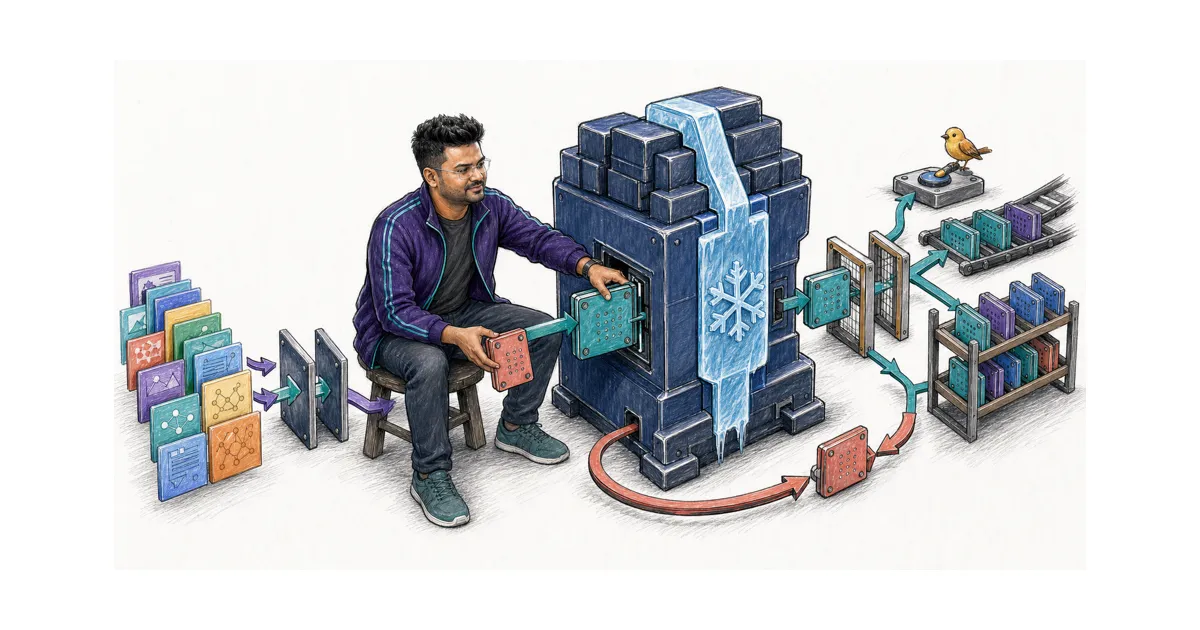
LoRA freezes the base weight matrix and learns a low-rank update represented by two smaller matrices. Rank controls adaptation capacity, while a scaling factor controls update magnitude. Target modules commonly include attention projections and sometimes feed-forward layers. More modules and higher rank increase trainable parameters but do not guarantee better generalization. Select them through task evaluation and inspect whether training loss improvements translate to held-out behavior.
Quantized LoRA reduces base-model memory during training by holding frozen weights in low precision while computing trainable adapters at suitable precision. It makes experimentation accessible, but optimizer state, activations, sequence length, and batch strategy still drive memory. Gradient checkpointing trades compute for activation storage. Track effective tokens per update and sequence packing so comparisons across runs reflect equivalent training exposure.
Adapters can remain separate for dynamic loading or be merged into base weights for simpler serving. Dynamic adapters support many tenants and quick rollback, but the server must batch by compatible adapter and include adapter identity in KV and prefix cache keys. Merging improves the ordinary inference path but creates a new full checkpoint. Preserve base version, adapter version, training recipe, and merge hash as one lineage.
Build data that teaches the intended boundary
Examples need both positive behavior and near-boundary negatives. For structured extraction, include missing fields, contradictory documents, unusual ordering, and inputs that should abstain. For tool use, include tool failures, requests requiring clarification, and actions outside permission. Homogeneous successful conversations teach the model to act confidently in exactly the situations where production needs restraint.
Normalize chat templates and tool schemas to match inference exactly. A training example rendered with a different role convention or function syntax can waste capacity learning an obsolete protocol. Mask loss where appropriate so the model learns assistant outputs rather than reproducing user text. Remove secrets, personal data, duplicated examples, test-set overlap, and model-generated artifacts that have not been reviewed for correctness.
Split data by source, customer, or time rather than randomly when nearby examples are near duplicates. Random splits can report excellent validation while testing memorization of the same template. Track dataset lineage to raw approved sources and make deletion possible. Review class balance and token balance; a few very long examples can dominate updates even when record counts look even.
Evaluate and operate adapters as releases
Compare the adapter with its exact base model on paired task cases, safety slices, general capability checks, latency, and output length. Fine-tuning can improve the target behavior while degrading unrelated instruction following or increasing verbosity. Evaluate multi-turn and tool trajectories where relevant. Inspect the largest changed examples rather than accepting one average score.
Deploy behind explicit routing with a fallback to the base model. Canary by tenant or request class, and monitor adapter load time, cache hit rate, batch fragmentation, tool errors, refusal changes, and cost. Keep adapters immutable after publication; a revised adapter gets a new version. This makes traces reproducible and lets one customer remain on a known version during investigation.
Refresh only when drift is demonstrated. Gather reviewed failures, update the evaluation suite first, then add training data and rerun earlier regression cases. Repeatedly fine-tuning on model mistakes without preserving prior examples creates oscillation and forgetting. A disciplined adapter program resembles software release engineering: small scoped changes, versioned dependencies, objective gates, controlled rollout, and fast rollback.
Research foundation and scope
LoRA freezes base weights and learns low-rank update matrices, while QLoRA combines low-rank adapters with a quantized frozen model to reduce training memory [LORA] [QLORA]. These techniques change behavior efficiently but do not turn training examples into a reliable mutable database. These sources establish the mechanism, but they do not remove the need to measure the local implementation. A paper's result belongs to its checkpoint, dataset, hardware, traffic, and experimental protocol; a standard describes a contract or risk practice, not a guarantee that a particular product follows it. The useful engineering move is to convert each cited idea into a hypothesis that can be falsified with representative inputs and observable intermediate state.
Adapter behavior depends on base checkpoint, tokenizer, chat template, rank and target modules, data mixture, optimizer, and serving merge strategy. Compatibility must be explicit for every deployed pair. Write these conditions into the design review before selecting a library or provider. Specify the authoritative source of truth, the authenticated principal, the versions that influence behavior, the maximum consequence of an error, and what the system will do when required evidence is missing. This boundary statement makes later optimization honest: teams can compare speed, cost, or convenience only after candidates satisfy the same correctness, authorization, privacy, and recovery contract.
Read [LORA], [QLORA], [NIST-GAI] together rather than treating one source as a recipe. LoRA: Low-Rank Adaptation of Large Language Models supplies one part of the foundation; QLoRA: Efficient Finetuning of Quantized LLMs supplies a second perspective; Artificial Intelligence Risk Management Framework: Generative Artificial Intelligence Profile helps connect the mechanism to evaluation, governance, or operations. The citations are deliberately primary papers, standards, or official documentation. Product-specific claims still require local evidence, and any dated behavior must be rechecked against the cited version before an article or architecture decision is refreshed.
A production implementation blueprint
Define the intended behavior boundary, curate consented and deduplicated examples, hold out realistic slices, record full data lineage, train reproducibly, scan artifacts, and route adapter identity through cache and evaluation keys. Begin with one thin vertical path that preserves all decision evidence. Give each run a stable identifier; capture normalized input, authenticated scope, relevant dependency versions, selected policy, timing, result status, and any external receipt. Keep large or sensitive payloads in a separately governed store and pass bounded references through the orchestration layer. This produces a debuggable system without making raw customer content the default telemetry substrate.
Make state transitions explicit and make every external boundary return a typed result. Distinguish validation failure, permission denial, missing evidence, rate limit, timeout, dependency outage, user cancellation, and internal defect. The distinction matters because each permits a different response: clarify, retry, fall back, defer, compensate, or stop. A generic exception handler that asks the model to try again turns uncertainty into repeated cost and can duplicate irreversible effects. Retries require an idempotency strategy and a stored receipt, not optimism.
Roll out the implementation as a versioned policy. Record which cohort receives it, what baseline it replaces, which metrics can stop the rollout, and how to reverse stateful artifacts such as indexes, caches, adapters, or workflow histories. Review privacy and retention alongside performance. If raw content is needed temporarily for diagnosis, state the purpose, access, sampling, encryption, and deletion window. Production readiness means the team can explain, contain, and reverse behavior under load—not merely demonstrate the happy path once.
Failure lab and evaluation plan
Compare prompting, retrieval, full tuning, LoRA, and QLoRA against the same task contracts. Sweep rank and data mixture, test catastrophic regressions on general behavior, and evaluate merged versus dynamically loaded serving paths. Keep the arrival pattern, data distribution, authorization, and dependency versions close to production. Use a paired baseline where possible and retain per-case results so averages cannot hide a severe slice. Offline evaluation should localize the failing stage; shadow evaluation should expose integration and traffic effects; a canary should confirm user-facing outcomes with a small blast radius. Each stage needs an exit criterion rather than a vague request to 'look good.'
Include label errors, memorized sensitive strings, incompatible tokenizer or base model, adapter hot-swap under load, stale draft model, mixed tenant cache, quantization regression, and rollback after a safety-policy update. Add adversarial boundary cases and partial failures, not only malformed inputs. Terminate a worker after an external system may have committed, revoke access after a cache was populated, change one dependency version, and delay one branch until its data is stale. Confirm that cancellation releases resources and that a fallback preserves semantics. The test passes only when the external outcome, audit evidence, and user-visible state agree; a fluent final message is not proof of completion.
Evaluation data needs lineage equal to production data. Record why each case exists, who reviewed the expected behavior, which source or policy supports it, and when it must be refreshed. Separate generated cases from production incidents and prevent test cases from leaking into training. When a metric changes, inspect changed examples before accepting an aggregate. A statistically small regression can still block release if it crosses an authorization, privacy, safety, or irreversible-action boundary.
Operating metrics and decision record
Use task success, slice regressions, calibration, memorization probes, training reproducibility, adapter load and switch latency, serving throughput, memory overhead, and outcome improvement over the simplest baseline. Define every metric with a numerator, denominator, unit, time window, exclusions, and responsible owner. Segment by workload and consequence so a dominant easy class cannot hide a rare costly failure. Pair service signals with product outcomes: latency without completion encourages fast useless answers, while answer quality without queue and cost data can produce an uneconomic service. Review percentiles and distributions rather than relying on a single average.
Fine-tune only when examples must teach a repeatable behavior that prompting or retrieval cannot maintain; operate every adapter as a versioned release artifact. Put that choice in a short architecture decision record containing context, alternatives, evidence, assumptions, selected policy, rollout, reversal trigger, and unresolved risk. Link the evaluation snapshot and source versions. This document prevents a benchmark from becoming folklore and tells the next engineer which evidence must be repeated when the model, provider, traffic, data, regulation, or product promise changes.
Monitor leading and lagging signals after release. Leading signals reveal pressure—queue age, cache allocation, disagreement, validation failure, policy denial, or retry growth—before users report harm. Lagging signals show whether the job was actually completed and trusted. Alert on a service objective tied to user consequence, and make the run identifier available to support without exposing private content. Every serious miss should become a reproducible regression case and, when relevant, a new threat or data-quality control.
Primary sources and further reading
- LoRA: Low-Rank Adaptation of Large Language ModelsOriginal research paper · paper
- QLoRA: Efficient Finetuning of Quantized LLMsOriginal research paper · paper
- Artificial Intelligence Risk Management Framework: Generative Artificial Intelligence ProfileNational Institute of Standards and Technology · standard
Written by

Co-founder & CTO of ViitorCloud · Founder of LaraCopilot · Organizer of Laracon India · Shipping production software since 2005
More about Vishal