The Software Engineer's Career Handbook
Deciding what to be good at while the machines get better
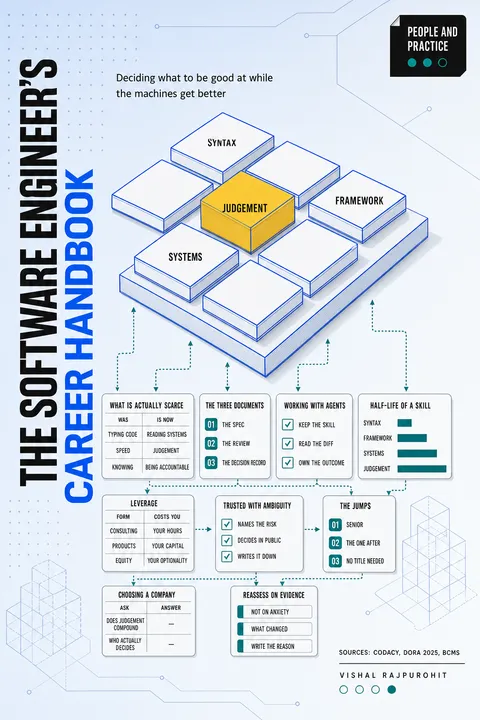
The scarce thing is no longer producing code; it is being accountable for judgement — reading systems, specifying intent, and being trusted with ambiguity.
Career advice written against the old ladder tells you to get faster at producing code, which is the part that stopped being scarce. This book is written against the shift instead: what is actually rare now, how to build comprehension and specification as deliberate skills, how to work with agents without losing the ability you would need without them, and how to choose problems, companies and forms of leverage that make judgement compound rather than depreciate.
Written for: Engineers from mid-level upward deciding where to put the next five years.
No chapter is published yet. The full contents below is the finished outline; chapters go live as they are written, and none of them will sit behind a signup.
What it makes operable
Outcomes, not topic coverage.
- 01Choose skills against what is actually scarce, not against last decade's ladder
- 02Work with agents without deskilling yourself
- 03Use writing — specs, reviews, decision records — as the leverage it has become
- 04Pick problems, companies and forms of leverage deliberately
Complete contents
12 chapters, in order.
Each chapter settles one decision, so it can be read on its own. Read in sequence to build the argument the book is making.
- 01In writing
What Is Actually Scarce Now
Judgement, accountability, and reading a system you did not build.
- 02In writing
Depth, Breadth, and the Half-Life of a Skill
Deciding what to learn deeply when the surface keeps moving under you.
- 03In writing
Reading Systems Faster Than You Write Them
Comprehension as deliberate practice, now the higher-leverage half of the job.
- 04In writing
Working With Agents Without Deskilling
Using the tool while keeping the ability you would need without it.
- 05In writing
Writing: Specs, Reviews, Decision Records
The three documents that decide how much influence you actually have.
- 06In writing
Being Trusted With Ambiguity
How work with no defined answer ends up assigned to specific people.
- 07In writing
Choosing Problems and Choosing Companies
Reading a business for whether your judgement will compound inside it.
- 08In writing
The Senior Jump, and the One After It
What changes at each threshold, stated as behaviour rather than as a title.
- 09In writing
Leading Without a Title
Influence built by being right in public, repeatedly.
- 10In writing
Community, Speaking, and Public Work
Why visible work changes which opportunities reach you at all.
- 11In writing
Leverage: Consulting, Products, Equity
Three ways to stop selling hours, and what each of them costs.
- 12In writing
Staying Employable for the Next Decade
Reassessing on evidence rather than on anxiety.
Evidence
What this book is arguing against.
Third-party sources behind the book's premise. Every figure in them belongs to the party that published it and is attributed to them in the text.
- AI Is Breaking Code Review: How Engineering Teams Fix the PR Bottleneck
Codacy · 2026-07-22 · Industry report · reported
- Key Takeaways from the DORA Report 2025: How AI is Reshaping Software Development Metrics and Team Performance
Faros AI · 2025-09-25 · Industry report · reported
- Spec-Driven Development (SDD): The Definitive 2026 Guide
BCMS · 2026-05-11 · Industry report · reported
Continue through the library
Adjacent operating manuals.
Agents That Finish
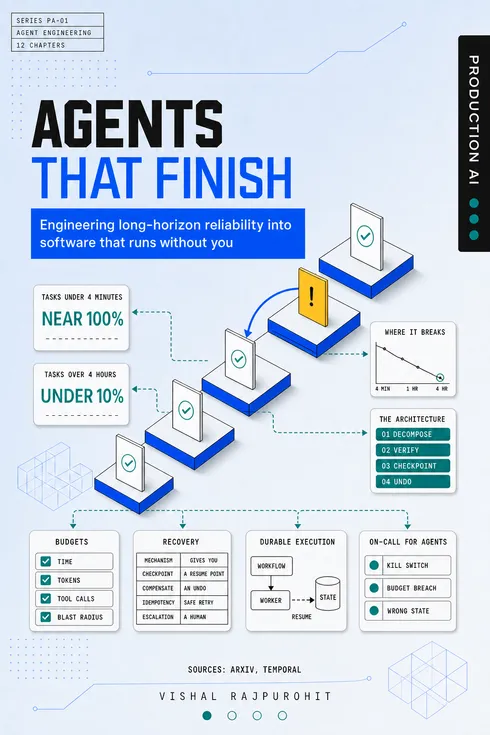
Frontier models are close to perfect on work a skilled person would finish in four minutes and close to useless on work that takes four hours. The gap is not intelligence. It is that most agent architectures cannot notice a wrong intermediate state, let alone roll one back, so the first bad commitment is inherited by every step after it. This book builds outwards from that failure mode: decomposition as a real artifact, verification between steps, checkpoints an agent can resume from, compensating actions for effects that already left the system, and budgets that bound the damage when none of it works.
Read the full book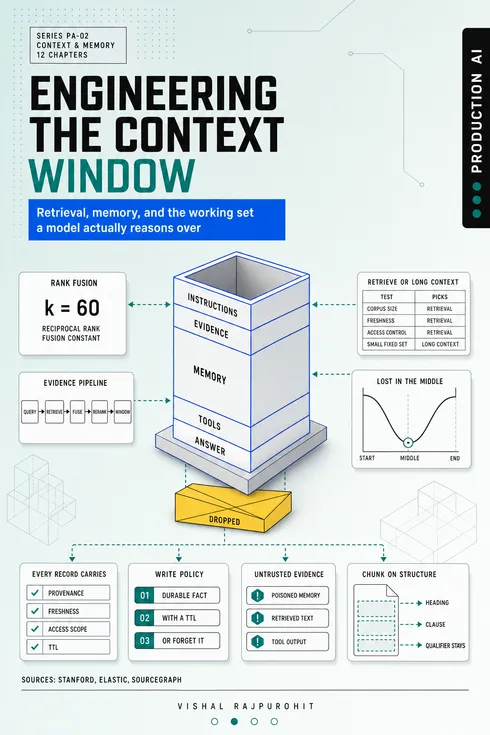
Engineering the Context Window
Retrieval, memory, compaction and ordering are usually built by different people at different times, and then the result is judged as though the model were the variable. This book treats them as a single system for deciding what the model sees: an evidence pipeline feeding a budgeted, ordered window, with provenance, freshness and access control surviving all the way into the prompt. It also takes the long-context argument seriously — long windows did kill lazy retrieval — and gives you the tests that show which parts of your own pipeline are now redundant.
Read the full book