AI Data Flywheels Without Feedback Pollution

A flywheel begins with observable outcomes
Product interaction becomes useful learning data only when it connects input, system configuration, output, user action, and eventual outcome. Store stable run identifiers and versions for prompts, models, retrieval, tools, and policy. A thumbs-up without the task result or exposure context is weak evidence. For a coding assistant, accepted patch, later revert, test outcome, and edit distance may reveal more than an immediate rating.
Define success by workflow. A support answer may be judged by resolution without reopen; a document extractor by corrected fields; an agent by verified task completion. Capture negative and delayed outcomes, not only easy positive clicks. Instrument abandonment carefully because users may leave after success or frustration. Combine behavioral events with targeted review rather than treating any one proxy as truth.
Respect purpose and consent. Tell users when interactions may improve the system, minimize collected content, and separate analytics from approved training data. Enterprise tenants may require opt-out, residency, or customer-specific isolation. Deletion and retention must propagate through raw events, reviewed datasets, embeddings, and derived examples. A flywheel that cannot honor data rights is operational liability.
Select examples by information value
Random sampling overrepresents common easy traffic. Prioritize disagreements between models, low verifier confidence, human corrections, escalations, novel clusters, policy boundaries, and high-impact failures. Keep a representative sample as a guard against tunnel vision. Selection policy should record why an example entered review so analysts can estimate bias and avoid treating the reviewed set as the production distribution.
Deduplicate near-identical prompts and templates before labeling. One incident burst can otherwise dominate the dataset and make progress look larger than it is. Cluster by semantic and structural features, then sample diverse members. Preserve frequency weights separately when common cases deserve more optimization. Diversity and prevalence are different objectives and should not be conflated.
Counterfactual logging can compare alternative model outputs offline when consent and cost allow. Avoid showing risky alternatives to users; score them with trusted evaluation and expert review. Pairwise comparisons often produce more consistent labels than absolute ratings. Record the production decision and candidate set so later router or reward models learn from the actual choice context.
Build a reviewed data promotion pipeline
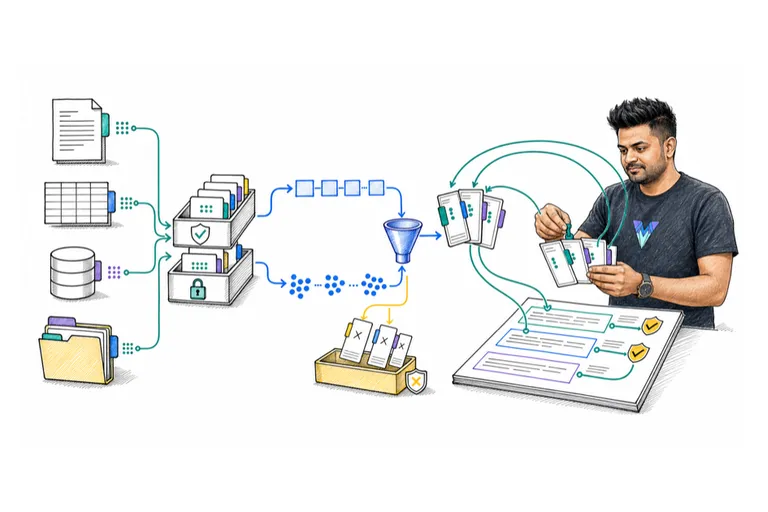
Raw feedback enters quarantine, where automated checks remove secrets, malware, duplicates, unsupported formats, and policy-prohibited content. Reviewers then apply task-specific rubrics with access limited to necessary context. High-impact examples may require two reviewers or domain experts. Store disagreements rather than forcing consensus when the task is genuinely ambiguous. Approved records become immutable dataset versions with lineage back to authorized sources.
Generated labels and synthetic examples can accelerate coverage but require validation. Mark their provenance and never allow a model’s answer to become ground truth merely because it is fluent. Use deterministic constraints, trusted documents, or expert review to validate. Keep human and synthetic performance slices separate so a system cannot appear improved by mastering artifacts of its own generator.
Before promotion, scan overlap with evaluation sets and previous splits. Split by user, source, time, or template to reduce leakage. Generate dataset cards describing purpose, population, exclusions, known biases, and retention. A training job references an immutable manifest, making results reproducible and enabling rollback if a source is later revoked or a labeling defect is discovered.
Prove the loop improves production
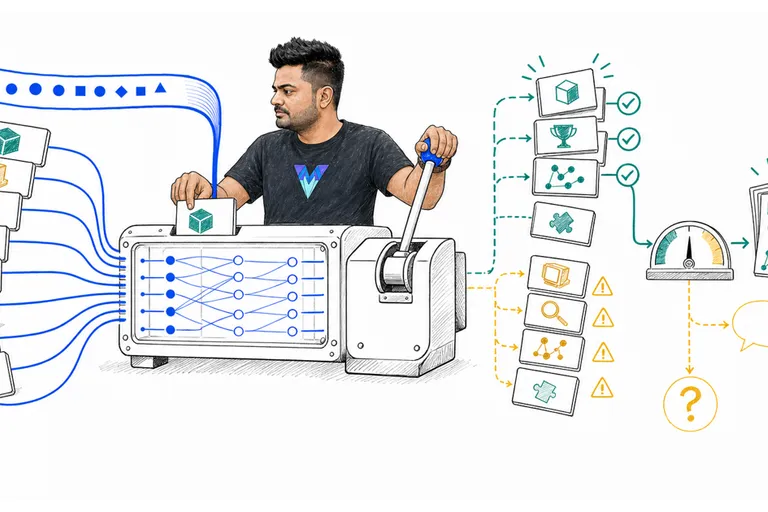
Train or tune on a bounded change, then evaluate against the stable trusted suite, recent failures, safety slices, and untouched temporal holdouts. Improvements on newly added examples may be memorization. Check generalization to neighboring cases and measure regressions outside the target. Keep the previous model available and document which dataset delta motivated the release.
Use canaries or controlled experiments to validate that offline gains change product outcomes. Monitor route mix, output length, latency, cost, and user behavior because a model can game proxies by becoming verbose or refusing more often. Feed only reviewed experiment outcomes into the next cycle. Automatically training on all production responses creates feedback pollution and can amplify the system’s own mistakes.
Measure flywheel velocity as time from detected failure to reviewed example, evaluated improvement, and safe deployment. Also measure yield: how many reviewed examples produce a meaningful fix. Low yield may indicate vague labels, architecture failures better solved outside training, or poor selection. A healthy flywheel is a disciplined learning system, not a large pile of transcripts.
Research foundation and scope
Research on hidden technical debt in machine-learning systems warns about feedback loops, entanglement, undeclared consumers, and changing external conditions [ML-DEBT]. A useful flywheel converts observed outcomes into reviewed evidence, not indiscriminate self-training. These sources establish the mechanism, but they do not remove the need to measure the local implementation. A paper's result belongs to its checkpoint, dataset, hardware, traffic, and experimental protocol; a standard describes a contract or risk practice, not a guarantee that a particular product follows it. The useful engineering move is to convert each cited idea into a hypothesis that can be falsified with representative inputs and observable intermediate state.
Clicks, acceptance, and silence are ambiguous. Model-generated text can re-enter data, popularity can amplify existing bias, and a changed product can invalidate yesterday's labels. Write these conditions into the design review before selecting a library or provider. Specify the authoritative source of truth, the authenticated principal, the versions that influence behavior, the maximum consequence of an error, and what the system will do when required evidence is missing. This boundary statement makes later optimization honest: teams can compare speed, cost, or convenience only after candidates satisfy the same correctness, authorization, privacy, and recovery contract.
Read [ML-DEBT], [NIST-GAI], [SELF-INSTRUCT] together rather than treating one source as a recipe. Hidden Technical Debt in Machine Learning Systems supplies one part of the foundation; Artificial Intelligence Risk Management Framework: Generative Artificial Intelligence Profile supplies a second perspective; Self-Instruct: Aligning Language Models with Self-Generated Instructions helps connect the mechanism to evaluation, governance, or operations. The citations are deliberately primary papers, standards, or official documentation. Product-specific claims still require local evidence, and any dated behavior must be rechecked against the cited version before an article or architecture decision is refreshed.
A production implementation blueprint
Define observable product outcomes, capture provenance and consent, separate human and model-authored content, select examples by information value, adjudicate labels independently, and promote data through versioned manifests. Begin with one thin vertical path that preserves all decision evidence. Give each run a stable identifier; capture normalized input, authenticated scope, relevant dependency versions, selected policy, timing, result status, and any external receipt. Keep large or sensitive payloads in a separately governed store and pass bounded references through the orchestration layer. This produces a debuggable system without making raw customer content the default telemetry substrate.
Make state transitions explicit and make every external boundary return a typed result. Distinguish validation failure, permission denial, missing evidence, rate limit, timeout, dependency outage, user cancellation, and internal defect. The distinction matters because each permits a different response: clarify, retry, fall back, defer, compensate, or stop. A generic exception handler that asks the model to try again turns uncertainty into repeated cost and can duplicate irreversible effects. Retries require an idempotency strategy and a stored receipt, not optimism.
Roll out the implementation as a versioned policy. Record which cohort receives it, what baseline it replaces, which metrics can stop the rollout, and how to reverse stateful artifacts such as indexes, caches, adapters, or workflow histories. Review privacy and retention alongside performance. If raw content is needed temporarily for diagnosis, state the purpose, access, sampling, encryption, and deletion window. Production readiness means the team can explain, contain, and reverse behavior under load—not merely demonstrate the happy path once.
Failure lab and evaluation plan
Compare random, uncertainty, diversity, and failure-driven sampling. Train or evaluate on time-separated splits, hold out users and entities, audit near-duplicates, and test whether gains survive a production-shaped shadow cohort. Keep the arrival pattern, data distribution, authorization, and dependency versions close to production. Use a paired baseline where possible and retain per-case results so averages cannot hide a severe slice. Offline evaluation should localize the failing stage; shadow evaluation should expose integration and traffic effects; a canary should confirm user-facing outcomes with a small blast radius. Each stage needs an exit criterion rather than a vague request to 'look good.'
Include automated users, copied model answers, reward gaming, popularity bias, changing UI, label-policy revision, deletion request, overrepresented heavy users, adversarial feedback, and a loop trained on its own confident errors. Add adversarial boundary cases and partial failures, not only malformed inputs. Terminate a worker after an external system may have committed, revoke access after a cache was populated, change one dependency version, and delay one branch until its data is stale. Confirm that cancellation releases resources and that a fallback preserves semantics. The test passes only when the external outcome, audit evidence, and user-visible state agree; a fluent final message is not proof of completion.
Evaluation data needs lineage equal to production data. Record why each case exists, who reviewed the expected behavior, which source or policy supports it, and when it must be refreshed. Separate generated cases from production incidents and prevent test cases from leaking into training. When a metric changes, inspect changed examples before accepting an aggregate. A statistically small regression can still block release if it crosses an authorization, privacy, safety, or irreversible-action boundary.
Operating metrics and decision record
Track unique reviewed failures, provenance completeness, label agreement, duplicate and model-content rate, slice coverage, offline-to-online correlation, outcome lift, deletion completion, and feedback-loop drift. Define every metric with a numerator, denominator, unit, time window, exclusions, and responsible owner. Segment by workload and consequence so a dominant easy class cannot hide a rare costly failure. Pair service signals with product outcomes: latency without completion encourages fast useless answers, while answer quality without queue and cost data can produce an uneconomic service. Review percentiles and distributions rather than relying on a single average.
Promote an example because it adds independently verified information about a named behavior, not merely because it is recent, abundant, or produced by the current model. Put that choice in a short architecture decision record containing context, alternatives, evidence, assumptions, selected policy, rollout, reversal trigger, and unresolved risk. Link the evaluation snapshot and source versions. This document prevents a benchmark from becoming folklore and tells the next engineer which evidence must be repeated when the model, provider, traffic, data, regulation, or product promise changes.
Monitor leading and lagging signals after release. Leading signals reveal pressure—queue age, cache allocation, disagreement, validation failure, policy denial, or retry growth—before users report harm. Lagging signals show whether the job was actually completed and trusted. Alert on a service objective tied to user consequence, and make the run identifier available to support without exposing private content. Every serious miss should become a reproducible regression case and, when relevant, a new threat or data-quality control.
Primary sources and further reading
- Hidden Technical Debt in Machine Learning SystemsOriginal research paper · paper
- Artificial Intelligence Risk Management Framework: Generative Artificial Intelligence ProfileNational Institute of Standards and Technology · standard
- Self-Instruct: Aligning Language Models with Self-Generated InstructionsOriginal research paper · paper
Written by

Co-founder & CTO of ViitorCloud · Founder of LaraCopilot · Organizer of Laracon India · Shipping production software since 2005
More about Vishal