Rerankers: The Quality Layer Between Search and Generation
Why first-stage similarity is insufficient
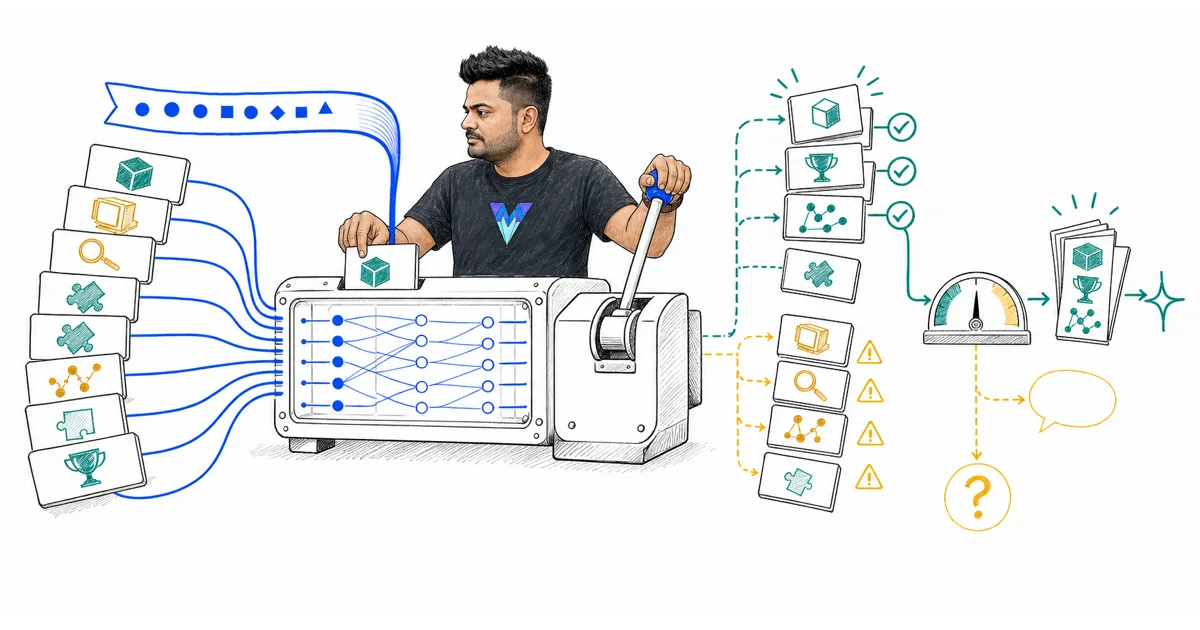
Candidate retrieval is optimized to search millions of items quickly, so it compresses away detail. A bi-encoder embeds the query and passage independently, which prevents direct token-level interaction. It can recognize broad topical similarity yet miss that a passage describes a different product version, reverses a condition, or merely mentions the query terms. A reranker sees the query and candidate together, spending more computation on a small set where fine distinctions matter.
Cross-encoders concatenate query and passage and produce a relevance score through full attention. They are accurate but scale linearly with candidate count and passage length. Late-interaction models encode tokens separately and compare token vectors at scoring time, occupying a useful middle ground between a single dense vector and full cross-attention. Select the architecture from the candidate budget, latency objective, and update pattern rather than assuming the largest reranker will create the best end-to-end answer.
Reranking cannot repair missing recall. If the correct passage is ranked 300th and only 50 candidates reach the reranker, better scoring changes nothing. Evaluate first-stage recall at several depths before tuning the second stage. Increasing candidate count improves opportunity but consumes latency and may expose the ranker to harder negatives. The operating point is where additional relevant recall justifies its scoring cost and does not crowd the list with duplicates.
Training labels and hard negatives
A reranker learns the meaning encoded in its judgments. Clicks are plentiful but biased by position, presentation, and user patience. Editorial labels are cleaner but expensive and can disagree on partially relevant passages. Define grades around the downstream task: fully answers, contains necessary evidence, topically related, or irrelevant. Preserve assessor disagreement when the question is ambiguous rather than forcing false certainty into one label.
Random negatives teach little because they are obviously unrelated. Hard negatives should resemble the query while failing for a precise reason: wrong version, wrong entity, incomplete procedure, outdated policy, or missing constraint. Mine them from the current retriever and refresh them after model changes. Include false friends that frequently fool production. Avoid labeling a passage negative merely because another answer was chosen; multiple documents can validly support the same question.
Pairwise objectives teach one candidate to outrank another, while listwise objectives align more directly with ordering a slate. Pointwise scores are convenient for filtering and calibration but may be less stable across queries. Whichever loss is used, evaluate the complete list and downstream evidence coverage. A ranker can improve a standard ranking metric by promoting duplicates, yet hurt generation by reducing source diversity and omitting one part of a multi-hop question.
Latency, batching, and passage shape
Reranking latency depends on total input tokens, not only candidate count. Truncating every passage to the same prefix may remove the matching clause near its end. Preserve section boundaries and create query-aware windows around lexical hits or dense subchunks. Batch candidate pairs to use accelerator throughput, but cap batch wait for interactive traffic. A small dedicated ranker can provide more stable tail latency than sharing a congested generation GPU.
Cache document-side representations for late-interaction models and immutable corpus content. Cross-encoders cannot fully precompute joint attention, though tokenization and static document features can still be cached. Version every cached artifact by model and tokenizer. When a passage changes, stale representations must be invalidated with the same discipline as the search index. An apparently random relevance regression is often a mixed-version cache rather than a changed model.
Use cascades when the candidate pool is large. A cheap classifier or late-interaction stage reduces hundreds of candidates to dozens, then a stronger cross-encoder scores the survivors. Set thresholds from measured recall and let high-confidence easy queries exit early. Cascades should expose stage-by-stage drop counts and the identities of discarded relevant examples during offline tests. Otherwise latency optimization quietly becomes evidence deletion.
Calibrating scores for product decisions
Ordering is enough for top-k selection, but many products also need to know whether any result is good enough. Raw reranker logits are not probabilities and may shift by query type or corpus. Calibrate on held-out production-like data using reliability curves, then validate by slices. A global threshold may reject short identifier queries while admitting verbose but unsupported conceptual matches. Query-class thresholds or a small confidence model can be safer.
Confidence should combine top score, margin to alternatives, retriever agreement, document authority, and evidence coverage. A large margin is meaningless if all candidates are irrelevant. For multi-part questions, require adequate evidence for each subquestion rather than one excellent passage. The resulting policy can choose to answer, ask a clarifying question, broaden retrieval, or abstain. This makes ranking scores part of a controlled decision instead of decorative telemetry.
Monitor score distributions, top-result turnover, stage latency, duplicate rate, and human correction outcomes. Corpus migrations and query shifts can invalidate calibration even when ranking metrics remain steady. Shadow new rerankers and inspect changed decisions, especially where the old system abstained and the new one answers. The costliest regression is often increased confidence on weak evidence, because fluent generation hides it until a user acts.
Research foundation and scope
Bi-encoders compare independently produced representations, while cross-encoders allow full query-passage interaction and late-interaction systems such as ColBERT retain token-level matching with reusable document representations [COLBERT] [SBERT]. These sources establish the mechanism, but they do not remove the need to measure the local implementation. A paper's result belongs to its checkpoint, dataset, hardware, traffic, and experimental protocol; a standard describes a contract or risk practice, not a guarantee that a particular product follows it. The useful engineering move is to convert each cited idea into a hypothesis that can be falsified with representative inputs and observable intermediate state.
A reranker refines recalled candidates; it cannot find a missing passage. Candidate count, total input tokens, truncation policy, duplicate density, and latency budget define the useful operating point. Write these conditions into the design review before selecting a library or provider. Specify the authoritative source of truth, the authenticated principal, the versions that influence behavior, the maximum consequence of an error, and what the system will do when required evidence is missing. This boundary statement makes later optimization honest: teams can compare speed, cost, or convenience only after candidates satisfy the same correctness, authorization, privacy, and recovery contract.
Read [COLBERT], [SBERT], [BEIR] together rather than treating one source as a recipe. ColBERT: Efficient and Effective Passage Search via Contextualized Late Interaction over BERT supplies one part of the foundation; Sentence-BERT: Sentence Embeddings using Siamese BERT-Networks supplies a second perspective; BEIR: A Heterogeneous Benchmark for Zero-shot Evaluation of Information Retrieval Models helps connect the mechanism to evaluation, governance, or operations. The citations are deliberately primary papers, standards, or official documentation. Product-specific claims still require local evidence, and any dated behavior must be rechecked against the cited version before an article or architecture decision is refreshed.
A production implementation blueprint
Mine hard negatives from the live retriever, label evidence usefulness rather than topicality, preserve query-aware passage windows, and use an observable cascade when a strong cross-encoder cannot score the whole pool. Begin with one thin vertical path that preserves all decision evidence. Give each run a stable identifier; capture normalized input, authenticated scope, relevant dependency versions, selected policy, timing, result status, and any external receipt. Keep large or sensitive payloads in a separately governed store and pass bounded references through the orchestration layer. This produces a debuggable system without making raw customer content the default telemetry substrate.
Make state transitions explicit and make every external boundary return a typed result. Distinguish validation failure, permission denial, missing evidence, rate limit, timeout, dependency outage, user cancellation, and internal defect. The distinction matters because each permits a different response: clarify, retry, fall back, defer, compensate, or stop. A generic exception handler that asks the model to try again turns uncertainty into repeated cost and can duplicate irreversible effects. Retries require an idempotency strategy and a stored receipt, not optimism.
Roll out the implementation as a versioned policy. Record which cohort receives it, what baseline it replaces, which metrics can stop the rollout, and how to reverse stateful artifacts such as indexes, caches, adapters, or workflow histories. Review privacy and retention alongside performance. If raw content is needed temporarily for diagnosis, state the purpose, access, sampling, encryption, and deletion window. Production readiness means the team can explain, contain, and reverse behavior under load—not merely demonstrate the happy path once.
Failure lab and evaluation plan
Measure recall before reranking, then compare nDCG, evidence coverage, source diversity, latency, and downstream answer support at several candidate depths. Calibrate answer thresholds on held-out, production-shaped query slices. Keep the arrival pattern, data distribution, authorization, and dependency versions close to production. Use a paired baseline where possible and retain per-case results so averages cannot hide a severe slice. Offline evaluation should localize the failing stage; shadow evaluation should expose integration and traffic effects; a canary should confirm user-facing outcomes with a small blast radius. Each stage needs an exit criterion rather than a vague request to 'look good.'
Include wrong-version passages, semantically similar negations, partial procedures, mirrored documentation, relevant text after the truncation boundary, and queries for which every candidate is irrelevant. Inspect changed abstain-to-answer decisions. Add adversarial boundary cases and partial failures, not only malformed inputs. Terminate a worker after an external system may have committed, revoke access after a cache was populated, change one dependency version, and delay one branch until its data is stale. Confirm that cancellation releases resources and that a fallback preserves semantics. The test passes only when the external outcome, audit evidence, and user-visible state agree; a fluent final message is not proof of completion.
Evaluation data needs lineage equal to production data. Record why each case exists, who reviewed the expected behavior, which source or policy supports it, and when it must be refreshed. Separate generated cases from production incidents and prevent test cases from leaking into training. When a metric changes, inspect changed examples before accepting an aggregate. A statistically small regression can still block release if it crosses an authorization, privacy, safety, or irreversible-action boundary.
Operating metrics and decision record
Track ranking quality, relevant-candidate drop by stage, input tokens, batching wait, top-score reliability, margin distributions, duplicate promotion, answer support, and corrections after high-confidence matches. Define every metric with a numerator, denominator, unit, time window, exclusions, and responsible owner. Segment by workload and consequence so a dominant easy class cannot hide a rare costly failure. Pair service signals with product outcomes: latency without completion encourages fast useless answers, while answer quality without queue and cost data can produce an uneconomic service. Review percentiles and distributions rather than relying on a single average.
Choose a reranker and threshold as a product decision policy, not merely a top-k sorter; confidence must reflect coverage and authority as well as a logit. Put that choice in a short architecture decision record containing context, alternatives, evidence, assumptions, selected policy, rollout, reversal trigger, and unresolved risk. Link the evaluation snapshot and source versions. This document prevents a benchmark from becoming folklore and tells the next engineer which evidence must be repeated when the model, provider, traffic, data, regulation, or product promise changes.
Monitor leading and lagging signals after release. Leading signals reveal pressure—queue age, cache allocation, disagreement, validation failure, policy denial, or retry growth—before users report harm. Lagging signals show whether the job was actually completed and trusted. Alert on a service objective tied to user consequence, and make the run identifier available to support without exposing private content. Every serious miss should become a reproducible regression case and, when relevant, a new threat or data-quality control.
Primary sources and further reading
- ColBERT: Efficient and Effective Passage Search via Contextualized Late Interaction over BERTOriginal research paper · paper
- Sentence-BERT: Sentence Embeddings using Siamese BERT-NetworksOriginal research paper · paper
- BEIR: A Heterogeneous Benchmark for Zero-shot Evaluation of Information Retrieval ModelsOriginal research paper · paper
Written by

Co-founder & CTO of ViitorCloud · Founder of LaraCopilot · Organizer of Laracon India · Shipping production software since 2005
More about Vishal