Hybrid Search: Making Lexical and Vector Retrieval Cooperate
The two retrievers fail differently
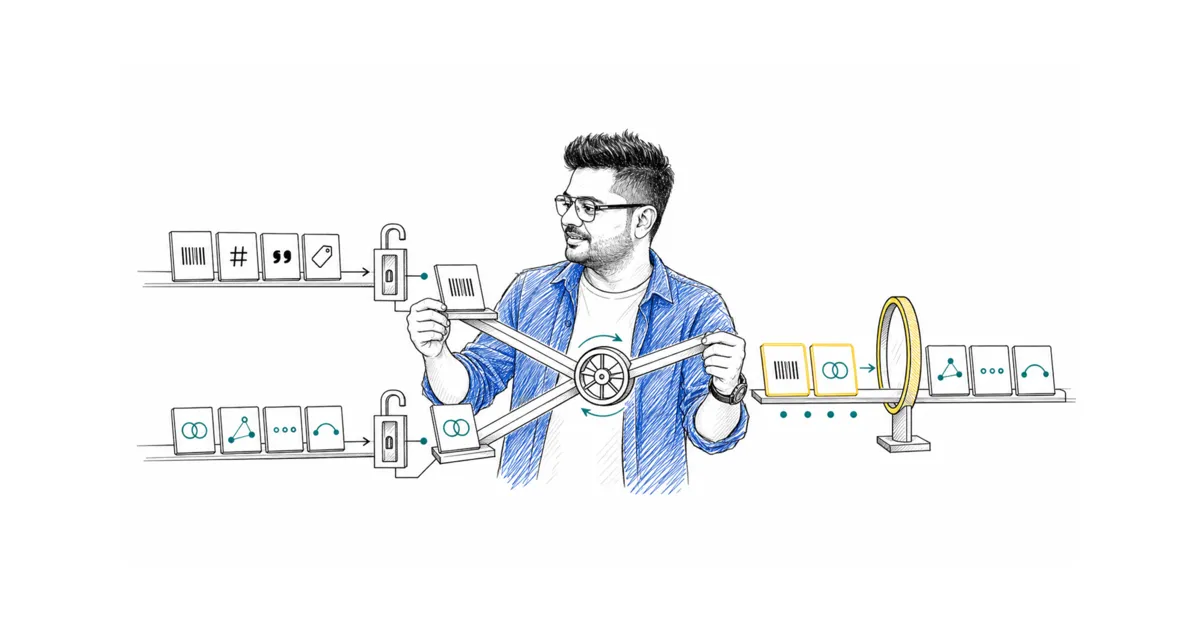
Lexical ranking rewards term overlap and corpus rarity, making it strong for error codes, part numbers, legal phrases, and newly coined names. It struggles when the question and document express the same idea with different vocabulary. Dense embeddings compress meaning into vectors and bridge paraphrases, but can blur exact distinctions such as product tiers, negation, or neighboring version numbers. Hybrid retrieval is valuable because these error modes are complementary, not because averaging two scores is inherently sophisticated.
Analyze disagreement rather than only aggregate recall. Label queries where lexical retrieval wins, dense retrieval wins, both win, or neither finds evidence. These slices reveal whether improvements require tokenization, synonym handling, a better embedding model, or better source content. A dense index that adds no unique relevant candidates consumes cost without value. Conversely, replacing lexical search after a good embedding benchmark may silently break support queries dominated by identifiers and copied log fragments.
Each retriever needs field-aware inputs. Lexical indexes can weight titles, headings, code identifiers, and body text differently. Dense retrieval may embed a contextualized chunk containing its document title and parent heading while returning only the original passage. Do not pollute displayed evidence with artificial prefixes. Keep an embedding input representation separate from the canonical content and version both. This makes re-embedding possible without rewriting source records or losing provenance.
Fuse ranks, not incomparable raw scores
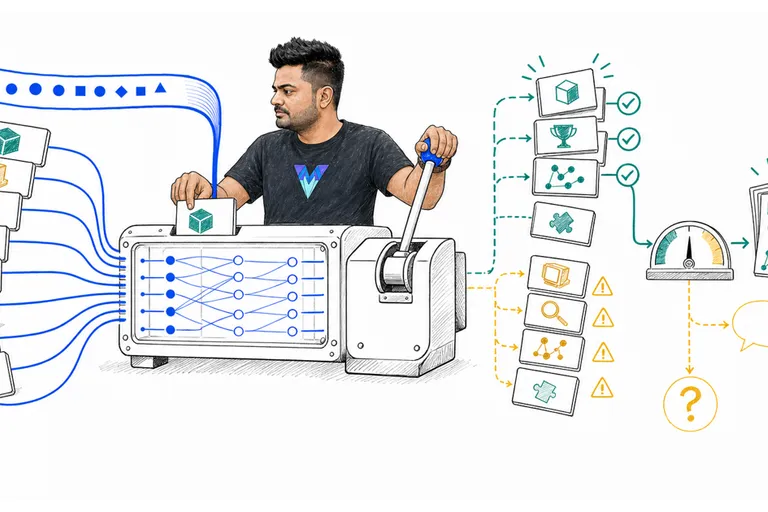
BM25 scores are unbounded and query-dependent, while cosine or dot-product similarities have distributions shaped by the embedding model and index. Directly adding raw values gives one system accidental control. Reciprocal rank fusion avoids score calibration by summing a decreasing function of each candidate’s rank. It is robust and easy to inspect, though it discards meaningful confidence gaps. Weighted variants can favor lexical retrieval for identifier-heavy queries or dense retrieval for natural-language concepts.
Score normalization can outperform rank-only fusion when calibrated carefully. Per-query min-max normalization is fragile because one outlier changes every candidate, and it makes a weak result set look confident. Learned fusion uses query features, retriever scores, ranks, document metadata, and historical labels to predict relevance. Keep the model small and observable at first. A fusion layer should improve candidate ordering without becoming an opaque second search engine that is impossible to debug when corpus behavior shifts.
Deduplicate by canonical source identity before allocating the reranker budget. Chunk overlap and mirrored documentation can produce several candidates containing the same sentence. Preserve the highest scoring passage and merge useful metadata, or group siblings for later parent expansion. Diversity constraints should be intentional: for a single-answer API question, the best passage matters most; for a policy comparison, multiple independent sources or versions may be necessary. The fusion policy can use the query type to choose between concentration and coverage.
const rrf = (ranks: number[], k = 60) =>
ranks.reduce((score, rank) => score + 1 / (k + rank), 0);Filters belong inside candidate generation
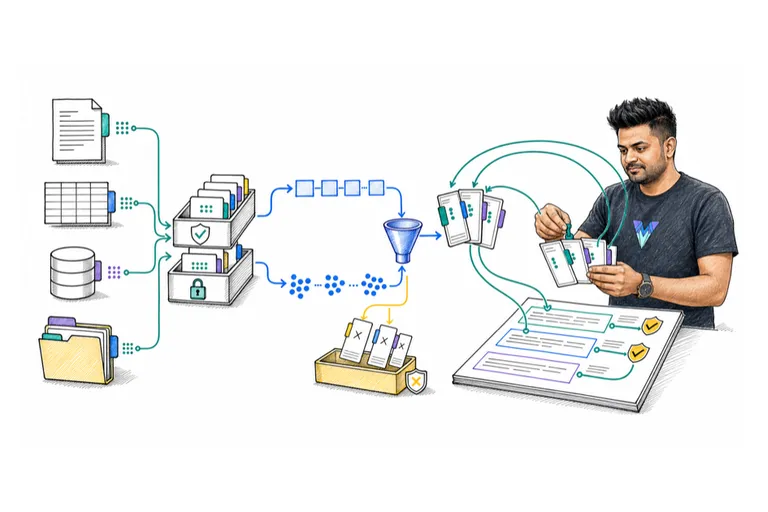
Metadata filters express hard constraints such as tenant, authorization, language, product version, region, and effective date. Applying them after approximate vector search can eliminate most of the top candidates and leave no relevant evidence. Prefer index-native prefiltering or filtered traversal that searches only eligible regions. When the engine cannot do this efficiently, over-fetch with a measured safety factor and monitor post-filter survivor counts, but recognize that this is a probabilistic workaround rather than correctness.
High-cardinality tenant filters can fragment an index or make graph traversal inefficient. Possible designs include separate indexes for large tenants, shared indexes with access-aware partitions, or encrypted document stores feeding tenant-local search. The choice depends on corpus size, update rate, isolation requirements, and operational overhead. Never rely on the generator to ignore unauthorized text after retrieval. If a passage crosses the model boundary, treat that as disclosure even if the final answer omits it.
Temporal filtering deserves special handling because documents can be valid over intervals rather than at one timestamp. Store effective-from and effective-to fields, and resolve the user’s requested time before retrieval. If no time is given, choose a documented default such as current authoritative content while retaining archived versions for historical questions. Rank freshness as a soft preference only after hard validity is satisfied; a recently edited blog post should not outrank an older binding specification merely because it is newer.
Tune against recall, latency, and corpus change
Build judgments at the passage level and allow multiple relevant candidates per query. Measure recall at the union stage, normalized discounted cumulative gain after fusion, and final evidence coverage after deduplication. Segment results by query pattern and filter selectivity. A single average can hide catastrophic identifier failures or poor multilingual recall. Record the index snapshot and retrieval configuration with each evaluation so score changes can be traced to code, model, parameters, or corpus.
Approximate nearest-neighbor parameters trade latency for recall. Graph search breadth, probe count, compression, and shard fan-out should be tuned under concurrent load, not on an idle laptop. Hybrid systems also pay two retrieval latencies, though calls can run in parallel. Set independent timeouts and design graceful degradation: a lexical result may still answer safely if vector search times out, while returning nothing may be better when permissions cannot be verified.
Corpus changes alter term statistics, vector neighborhoods, and duplicate density. Re-evaluate after major ingestion waves, tokenizer changes, embedding upgrades, or metadata migrations. Shadow a new index against production queries and compare candidate overlap before switching traffic. Keep a rollback path that includes the previous embeddings and lexical snapshot. Search quality is stateful infrastructure; deploying identical code against a changed index can create a larger behavioral change than deploying a new model.
Research foundation and scope
Lexical retrieval preserves rare terms and identifiers; dense retrieval bridges paraphrases; reciprocal rank fusion combines result positions without pretending their raw scores share a scale [RRF] [SBERT]. Their errors are complementary but corpus dependent. These sources establish the mechanism, but they do not remove the need to measure the local implementation. A paper's result belongs to its checkpoint, dataset, hardware, traffic, and experimental protocol; a standard describes a contract or risk practice, not a guarantee that a particular product follows it. The useful engineering move is to convert each cited idea into a hypothesis that can be falsified with representative inputs and observable intermediate state.
Fusion cannot recover evidence absent from both candidate sets, and post-filtering cannot repair unauthorized exposure. Field construction, tokenization, embedding inputs, index generation, and hard metadata filters are part of the retrieval contract. Write these conditions into the design review before selecting a library or provider. Specify the authoritative source of truth, the authenticated principal, the versions that influence behavior, the maximum consequence of an error, and what the system will do when required evidence is missing. This boundary statement makes later optimization honest: teams can compare speed, cost, or convenience only after candidates satisfy the same correctness, authorization, privacy, and recovery contract.
Read [RRF], [SBERT], [BEIR] together rather than treating one source as a recipe. Reciprocal Rank Fusion Outperforms Condorcet and Individual Rank Learning Methods supplies one part of the foundation; Sentence-BERT: Sentence Embeddings using Siamese BERT-Networks supplies a second perspective; BEIR: A Heterogeneous Benchmark for Zero-shot Evaluation of Information Retrieval Models helps connect the mechanism to evaluation, governance, or operations. The citations are deliberately primary papers, standards, or official documentation. Product-specific claims still require local evidence, and any dated behavior must be rechecked against the cited version before an article or architecture decision is refreshed.
A production implementation blueprint
Run lexical and dense retrieval in parallel, version each representation, prefilter by authorization and validity, fuse canonical document identities, remove overlap, and reserve reranker capacity for unique candidates. Keep original and rewritten queries observable. Begin with one thin vertical path that preserves all decision evidence. Give each run a stable identifier; capture normalized input, authenticated scope, relevant dependency versions, selected policy, timing, result status, and any external receipt. Keep large or sensitive payloads in a separately governed store and pass bounded references through the orchestration layer. This produces a debuggable system without making raw customer content the default telemetry substrate.
Make state transitions explicit and make every external boundary return a typed result. Distinguish validation failure, permission denial, missing evidence, rate limit, timeout, dependency outage, user cancellation, and internal defect. The distinction matters because each permits a different response: clarify, retry, fall back, defer, compensate, or stop. A generic exception handler that asks the model to try again turns uncertainty into repeated cost and can duplicate irreversible effects. Retries require an idempotency strategy and a stored receipt, not optimism.
Roll out the implementation as a versioned policy. Record which cohort receives it, what baseline it replaces, which metrics can stop the rollout, and how to reverse stateful artifacts such as indexes, caches, adapters, or workflow histories. Review privacy and retention alongside performance. If raw content is needed temporarily for diagnosis, state the purpose, access, sampling, encryption, and deletion window. Production readiness means the team can explain, contain, and reverse behavior under load—not merely demonstrate the happy path once.
Failure lab and evaluation plan
Label where lexical wins, dense wins, both win, and neither wins. Tune candidate depth and approximate-index breadth under concurrent load, then compare rank fusion, calibrated score fusion, and a small learned fusion model. Keep the arrival pattern, data distribution, authorization, and dependency versions close to production. Use a paired baseline where possible and retain per-case results so averages cannot hide a severe slice. Offline evaluation should localize the failing stage; shadow evaluation should expose integration and traffic effects; a canary should confirm user-facing outcomes with a small blast radius. Each stage needs an exit criterion rather than a vague request to 'look good.'
Test copied error codes, negation, adjacent version numbers, multilingual paraphrases, selective tenants, deleted documents, vector timeout, and an ingestion wave that changes term statistics. Exercise each retriever's independent fallback. Add adversarial boundary cases and partial failures, not only malformed inputs. Terminate a worker after an external system may have committed, revoke access after a cache was populated, change one dependency version, and delay one branch until its data is stale. Confirm that cancellation releases resources and that a fallback preserves semantics. The test passes only when the external outcome, audit evidence, and user-visible state agree; a fluent final message is not proof of completion.
Evaluation data needs lineage equal to production data. Record why each case exists, who reviewed the expected behavior, which source or policy supports it, and when it must be refreshed. Separate generated cases from production incidents and prevent test cases from leaking into training. When a metric changes, inspect changed examples before accepting an aggregate. A statistically small regression can still block release if it crosses an authorization, privacy, safety, or irreversible-action boundary.
Operating metrics and decision record
Use unique relevant recall from each retriever, union recall, nDCG after fusion, survivor count after filters, duplicate rate, rerank evidence coverage, p95 latency, and index-to-index candidate turnover. Define every metric with a numerator, denominator, unit, time window, exclusions, and responsible owner. Segment by workload and consequence so a dominant easy class cannot hide a rare costly failure. Pair service signals with product outcomes: latency without completion encourages fast useless answers, while answer quality without queue and cost data can produce an uneconomic service. Review percentiles and distributions rather than relying on a single average.
Retain both retrievers only when each contributes useful recall or resilience, and version the fusion policy with the index snapshot so quality changes remain attributable. Put that choice in a short architecture decision record containing context, alternatives, evidence, assumptions, selected policy, rollout, reversal trigger, and unresolved risk. Link the evaluation snapshot and source versions. This document prevents a benchmark from becoming folklore and tells the next engineer which evidence must be repeated when the model, provider, traffic, data, regulation, or product promise changes.
Monitor leading and lagging signals after release. Leading signals reveal pressure—queue age, cache allocation, disagreement, validation failure, policy denial, or retry growth—before users report harm. Lagging signals show whether the job was actually completed and trusted. Alert on a service objective tied to user consequence, and make the run identifier available to support without exposing private content. Every serious miss should become a reproducible regression case and, when relevant, a new threat or data-quality control.
Primary sources and further reading
- Reciprocal Rank Fusion Outperforms Condorcet and Individual Rank Learning MethodsOriginal research paper · paper
- Sentence-BERT: Sentence Embeddings using Siamese BERT-NetworksOriginal research paper · paper
- BEIR: A Heterogeneous Benchmark for Zero-shot Evaluation of Information Retrieval ModelsOriginal research paper · paper
Written by

Co-founder & CTO of ViitorCloud · Founder of LaraCopilot · Organizer of Laracon India · Shipping production software since 2005
More about Vishal