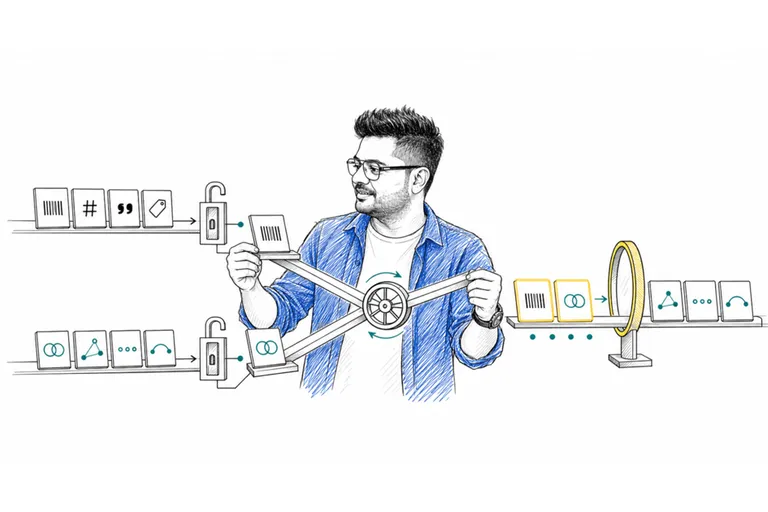
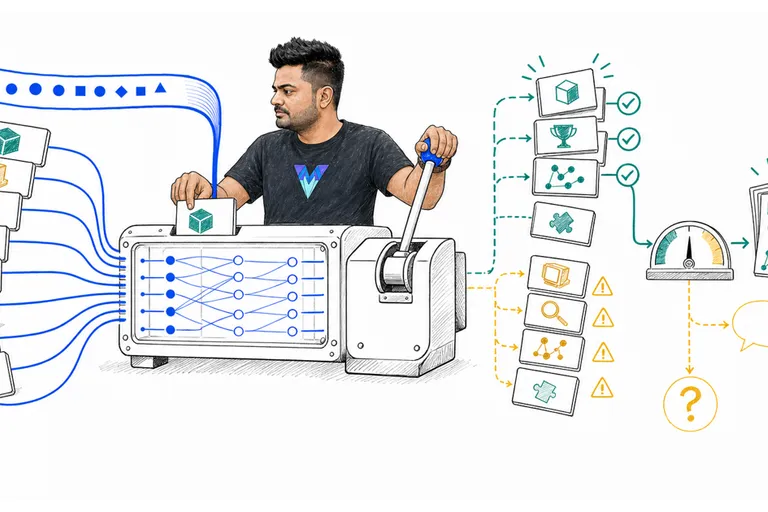
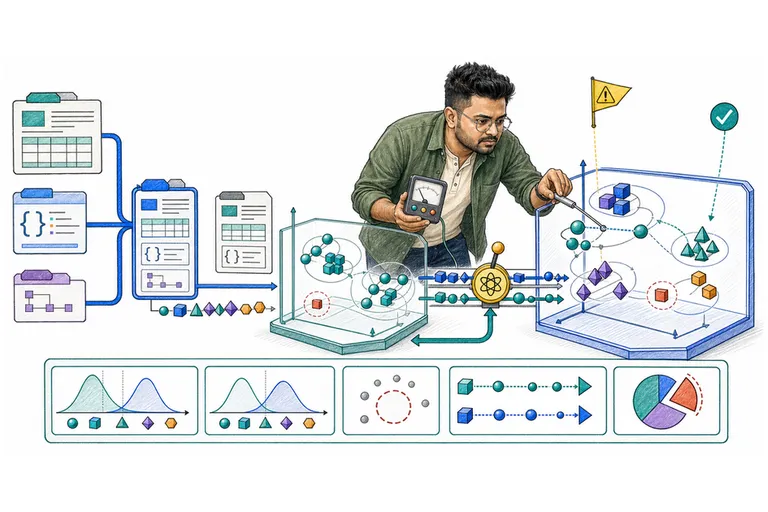
Production RAG Is an Evidence Pipeline, Not a Vector Search
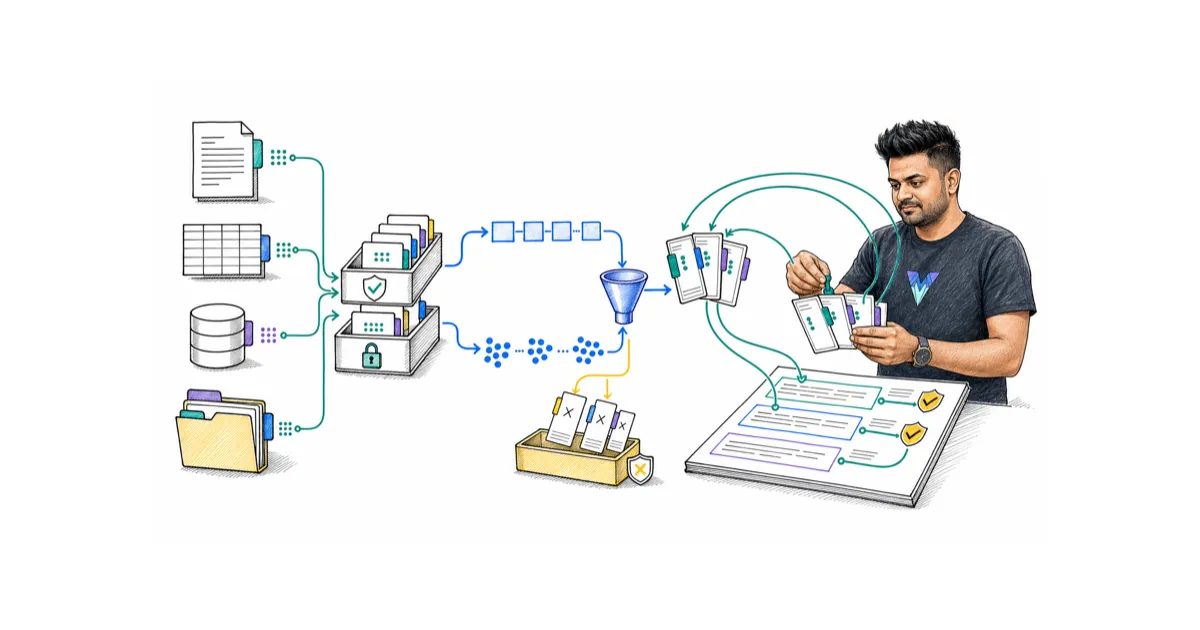
Start with answerable information units
RAG quality is constrained before the first embedding is computed. Source documents carry headings, tables, revisions, access controls, and relationships that flat text extraction can destroy. Build ingestion as a versioned pipeline with parser identity, source checksum, extraction warnings, and document lineage. Preserve page or section anchors so an answer can point back to evidence. If a PDF table becomes scrambled text, no embedding model can reconstruct the original row semantics reliably.
Chunking should follow the unit a user question needs. Fixed token windows are useful fallbacks, but contracts, API references, and incident reports have different boundaries. Keep parent-child structure: retrieve a narrow clause or function, then expand to its containing section for sufficient context. Store titles, hierarchy, effective dates, product versions, owners, and permissions as filterable metadata. Overlap is not free; it increases index size and can fill the final context with near-duplicate passages that crowd out independent evidence.
Every chunk should be reproducible from a source version. When a document changes, diff it, update affected chunks, and retire stale entries atomically. A mixed index containing both old and new policy text can produce an answer no version supports. Tombstones must propagate to lexical indexes, vector indexes, caches, and derived summaries. Treat deletion and permission revocation as correctness-critical operations with measurable lag, not housekeeping jobs that eventually converge.
Retrieve with a query plan
A user utterance is not always a good search query. It may contain pronouns from conversation, several subquestions, an incorrect product name, or a date constraint expressed indirectly. Query planning can resolve conversational references, extract filters, and split compound questions while retaining the original wording for audit. Keep transformations observable: aggressive rewriting sometimes removes the rare term that would have found the correct passage. Running both original and rewritten queries gives the retriever a safer candidate union.
Dense retrieval captures semantic similarity, while lexical retrieval excels at identifiers, error codes, names, and exact phrases. Production RAG commonly needs both, followed by rank fusion and a cross-encoder or late-interaction reranker. Apply access and hard version filters before ranking whenever possible. Filtering after retrieval can leave too few authorized candidates and produce unstable answers. Calibrate candidate counts from recall tests; top five is not a universal truth, and reranking cannot recover a relevant passage that the first stage never returned.
Some questions require structured tools rather than document retrieval. Current inventory belongs in a database query, account status in an authenticated API, and arithmetic in deterministic code. A router should choose among indexes and tools using explicit capabilities and authorization context. Avoid letting a general model invent SQL against an undocumented schema. Give it curated query functions or a semantic layer, validate parameters, impose limits, and return provenance that can join the same evidence bundle as retrieved text.
Assemble evidence before writing prose
The generation model needs a compact evidence packet, not an arbitrary concatenation of top-ranked chunks. Deduplicate overlapping passages, prefer source diversity when corroboration matters, and order context by the reasoning structure of the question. Include stable evidence IDs, source titles, dates, and short location labels next to each passage. Keep instructions clearly separated from retrieved content because documents may contain text that resembles system commands. The model should treat every retrieved string as untrusted evidence, never as authority to change behavior.
Context compression can extract relevant sentences or produce query-focused summaries, but every transformation risks dropping qualifiers. Preserve links from compressed claims to original spans and use extractive methods for high-stakes material when possible. Token budgeting should reserve space for the answer and citations rather than filling the entire model window. Longer context can dilute attention, increase latency, and raise cost. Evidence selection should stop when added passages contribute little new coverage, not when an arbitrary token maximum is reached.
Generate in a schema that separates answer text, claim-to-evidence mappings, uncertainty, and missing information. The application can render citations only after verifying that every referenced evidence ID exists and that the cited span plausibly supports the claim. For sensitive workflows, run a second entailment or consistency pass over each claim and its evidence. This verifier is imperfect, but it catches unsupported elaboration and citation drift better than asking the original generator to self-certify in the same prompt.
Evaluate retrieval and generation separately
An end-to-end answer score cannot tell whether failure came from parsing, retrieval, reranking, context assembly, or generation. Build a query set with known relevant evidence and measure recall at the candidate stage, ranking quality after reranking, and evidence coverage in the final packet. Then evaluate claim correctness, citation support, completeness, and abstention behavior. A fluent wrong answer may have perfect retrieval, while an honest refusal may reveal that ingestion omitted the needed document.
Create slices for exact identifiers, multi-hop questions, temporal conflicts, permission boundaries, tables, multilingual queries, and genuinely unanswerable requests. Record source versions with each test so the expected evidence remains reproducible. Use subject-matter review to establish a trusted core, then expand with production failures and carefully validated synthetic variants. LLM judges can accelerate scoring, but calibrate them against human labels and prevent the judge from seeing metadata that the answer system did not have.
Online metrics should connect retrieval behavior to outcomes without treating clicks as truth. Track citation opens, reformulations, escalations, accepted resolutions, latency, and the fraction of answers that abstain. Investigate shifts in query mix and corpus freshness before blaming the model. A RAG system is a living data product: index lag, permission changes, new terminology, and source conflicts can degrade it even when model and code remain unchanged.
Research foundation and scope
Retrieval-augmented generation combines parametric generation with an external non-parametric memory, originally motivated in part by provenance and update limitations in parameter-only systems [RAG]. Production systems extend that idea into parsing, authorization, ranking, evidence assembly, and claim verification. These sources establish the mechanism, but they do not remove the need to measure the local implementation. A paper's result belongs to its checkpoint, dataset, hardware, traffic, and experimental protocol; a standard describes a contract or risk practice, not a guarantee that a particular product follows it. The useful engineering move is to convert each cited idea into a hypothesis that can be falsified with representative inputs and observable intermediate state.
A vector match is neither authority nor permission. Source version, effective date, section structure, parser fidelity, user access, and whether the question belongs in a transactional system determine what evidence may support an answer. Write these conditions into the design review before selecting a library or provider. Specify the authoritative source of truth, the authenticated principal, the versions that influence behavior, the maximum consequence of an error, and what the system will do when required evidence is missing. This boundary statement makes later optimization honest: teams can compare speed, cost, or convenience only after candidates satisfy the same correctness, authorization, privacy, and recovery contract.
Read [RAG], [RRF], [NIST-GAI] together rather than treating one source as a recipe. Retrieval-Augmented Generation for Knowledge-Intensive NLP Tasks supplies one part of the foundation; Reciprocal Rank Fusion Outperforms Condorcet and Individual Rank Learning Methods supplies a second perspective; Artificial Intelligence Risk Management Framework: Generative Artificial Intelligence Profile helps connect the mechanism to evaluation, governance, or operations. The citations are deliberately primary papers, standards, or official documentation. Product-specific claims still require local evidence, and any dated behavior must be rechecked against the cited version before an article or architecture decision is refreshed.
A production implementation blueprint
Preserve canonical source anchors and lineage, retrieve with lexical and dense candidates, apply hard authorization before model exposure, rerank, deduplicate, and assemble evidence IDs. Generate claim-to-evidence mappings and reject unknown citations. Begin with one thin vertical path that preserves all decision evidence. Give each run a stable identifier; capture normalized input, authenticated scope, relevant dependency versions, selected policy, timing, result status, and any external receipt. Keep large or sensitive payloads in a separately governed store and pass bounded references through the orchestration layer. This produces a debuggable system without making raw customer content the default telemetry substrate.
Make state transitions explicit and make every external boundary return a typed result. Distinguish validation failure, permission denial, missing evidence, rate limit, timeout, dependency outage, user cancellation, and internal defect. The distinction matters because each permits a different response: clarify, retry, fall back, defer, compensate, or stop. A generic exception handler that asks the model to try again turns uncertainty into repeated cost and can duplicate irreversible effects. Retries require an idempotency strategy and a stored receipt, not optimism.
Roll out the implementation as a versioned policy. Record which cohort receives it, what baseline it replaces, which metrics can stop the rollout, and how to reverse stateful artifacts such as indexes, caches, adapters, or workflow histories. Review privacy and retention alongside performance. If raw content is needed temporarily for diagnosis, state the purpose, access, sampling, encryption, and deletion window. Production readiness means the team can explain, contain, and reverse behavior under load—not merely demonstrate the happy path once.
Failure lab and evaluation plan
Create a gold set with known relevant spans and unanswerable questions. Measure candidate recall, reranker ordering, final evidence coverage, claim support, and abstention separately so a fluent answer cannot hide a missing document. Keep the arrival pattern, data distribution, authorization, and dependency versions close to production. Use a paired baseline where possible and retain per-case results so averages cannot hide a severe slice. Offline evaluation should localize the failing stage; shadow evaluation should expose integration and traffic effects; a canary should confirm user-facing outcomes with a small blast radius. Each stage needs an exit criterion rather than a vague request to 'look good.'
Inject an outdated policy, a malformed PDF table, duplicate chunks, a deleted source, conflicting versions, prompt-like text inside a document, and an unauthorized high-similarity passage. Confirm atomic invalidation across indexes and caches. Add adversarial boundary cases and partial failures, not only malformed inputs. Terminate a worker after an external system may have committed, revoke access after a cache was populated, change one dependency version, and delay one branch until its data is stale. Confirm that cancellation releases resources and that a fallback preserves semantics. The test passes only when the external outcome, audit evidence, and user-visible state agree; a fluent final message is not proof of completion.
Evaluation data needs lineage equal to production data. Record why each case exists, who reviewed the expected behavior, which source or policy supports it, and when it must be refreshed. Separate generated cases from production incidents and prevent test cases from leaking into training. When a metric changes, inspect changed examples before accepting an aggregate. A statistically small regression can still block release if it crosses an authorization, privacy, safety, or irreversible-action boundary.
Operating metrics and decision record
Track ingestion lag, parse warnings, authorized recall, ranking quality, evidence diversity, citation support, unsupported-claim rate, abstention precision, citation opens, corrections, and resolution outcomes. Define every metric with a numerator, denominator, unit, time window, exclusions, and responsible owner. Segment by workload and consequence so a dominant easy class cannot hide a rare costly failure. Pair service signals with product outcomes: latency without completion encourages fast useless answers, while answer quality without queue and cost data can produce an uneconomic service. Review percentiles and distributions rather than relying on a single average.
Treat every answer as a release of traceable evidence: if the system cannot identify current authorized support for the material claims, it must narrow, clarify, or abstain. Put that choice in a short architecture decision record containing context, alternatives, evidence, assumptions, selected policy, rollout, reversal trigger, and unresolved risk. Link the evaluation snapshot and source versions. This document prevents a benchmark from becoming folklore and tells the next engineer which evidence must be repeated when the model, provider, traffic, data, regulation, or product promise changes.
Monitor leading and lagging signals after release. Leading signals reveal pressure—queue age, cache allocation, disagreement, validation failure, policy denial, or retry growth—before users report harm. Lagging signals show whether the job was actually completed and trusted. Alert on a service objective tied to user consequence, and make the run identifier available to support without exposing private content. Every serious miss should become a reproducible regression case and, when relevant, a new threat or data-quality control.
Primary sources and further reading
- Retrieval-Augmented Generation for Knowledge-Intensive NLP TasksOriginal research paper · paper
- Reciprocal Rank Fusion Outperforms Condorcet and Individual Rank Learning MethodsOriginal research paper · paper
- Artificial Intelligence Risk Management Framework: Generative Artificial Intelligence ProfileNational Institute of Standards and Technology · standard
Written by

Co-founder & CTO of ViitorCloud · Founder of LaraCopilot · Organizer of Laracon India · Shipping production software since 2005
More about Vishal