Embedding Systems: Models, Indexes, and Semantic Drift
Choose a representation for the task
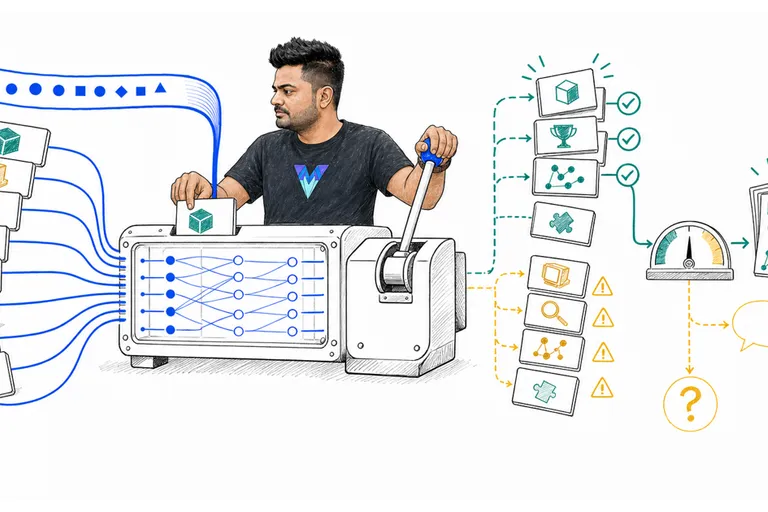
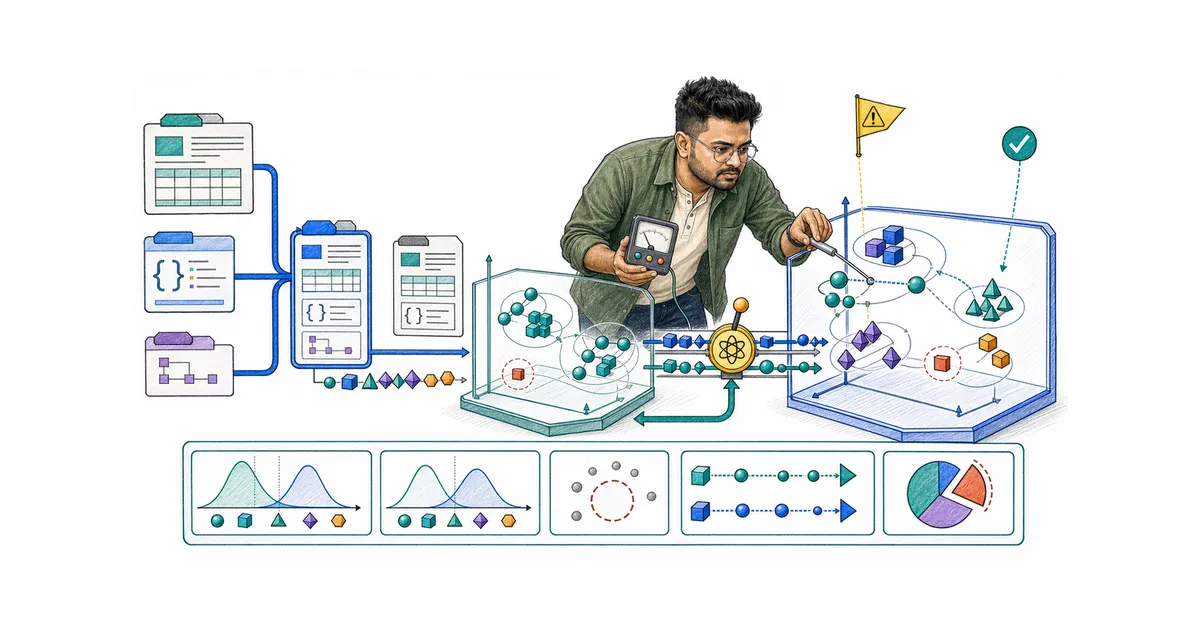
An embedding model defines which distinctions become distance. General semantic similarity may not align with legal clause retrieval, code search, product matching, or recommendation. Build a labeled query-document set from the intended domain and compare recall, ranking, multilingual behavior, latency, and storage. Public leaderboard gains can disappear when queries contain internal acronyms, exact identifiers, or domain-specific negation.
Some models expect asymmetric prefixes such as query and passage instructions; omitting them changes geometry. Others support task prompts or variable dimensions. Follow the model’s documented normalization and similarity function. Cosine, inner product, and Euclidean distance are not interchangeable unless vectors and index settings make them so. Store embedding model, tokenizer, dimension, normalization, and input-template version with every vector.
Representation can be multi-vector. A document may have separate title, body, code, and entity embeddings, while late-interaction systems retain token-level vectors. This increases storage and scoring complexity but preserves signals a single pooled vector erases. Start with the simplest representation that reaches required recall, then add complexity for demonstrated failure slices rather than embedding every field because the database permits it.
Construct inputs without corrupting source truth
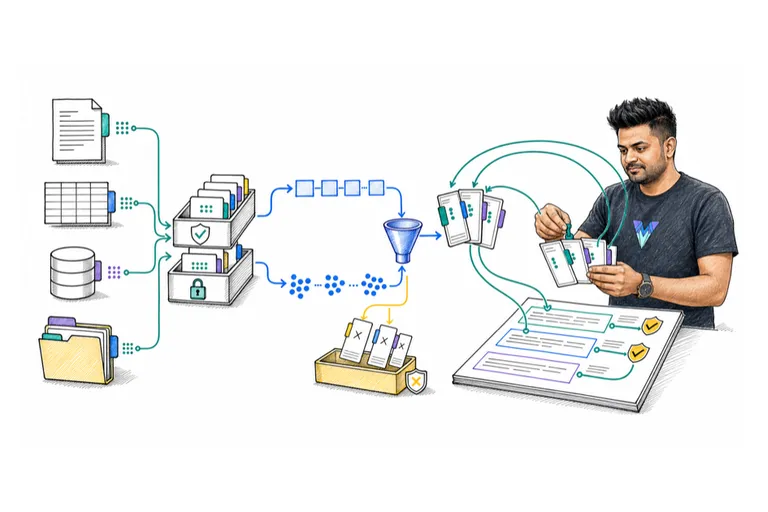
A chunk often lacks context when embedded alone. Prepend its document title, hierarchy, product, and version to create a contextualized embedding input, while keeping canonical text unchanged for display and citation. Version this template because punctuation, field order, and boilerplate affect vectors. Avoid repeating common navigation text across every chunk; it can dominate similarity and create dense clusters around irrelevant site language.
Chunk length changes semantic resolution. Long chunks average several topics into one vector, while tiny fragments lose enough context to become ambiguous. Use document structure and answer units, then test several sizes. For code, function or class boundaries often outperform arbitrary token windows. For tables, serialize headers with each row or create purpose-built representations. The parser and chunker are part of the embedding model in practical terms.
Deduplicate before embedding to reduce cost and neighborhood crowding. Exact hashes catch copies; near-duplicate methods identify templates and mirrored pages. Preserve canonical relationships so retrieval can still return the authorized source version. Deduplication must respect permissions and temporal validity—two identical passages in different tenant documents are not interchangeable if their access policies differ.
Engineer the index for recall and operations
Approximate indexes trade exact nearest neighbors for speed. Graph indexes offer strong low-latency recall but can consume substantial memory and make updates or filtered traversal complex. Inverted-file and product-quantization designs compress larger corpora with tunable probes. Benchmark build time, query recall, update behavior, filter selectivity, and recovery—not just median latency on an immutable sample.
Sharding changes neighborhoods. Routing a query to too few shards can miss relevant vectors; searching all shards increases network and merge cost. Partition by tenant or domain when queries have reliable routing keys, otherwise balance shards and fan out. Replicas improve availability but require index-version consistency. Include index generation in responses and traces so mixed rollouts can be diagnosed.
Deletes and updates need lifecycle guarantees. A tombstoned vector may remain reachable until compaction, which is unacceptable for revoked sensitive content. Understand the engine’s deletion semantics and maintain a deny filter until physical removal. Back up source records and embedding recipes, not only proprietary index files, so the index can be rebuilt after corruption or a model migration.
Migrate models and monitor semantic drift
Embeddings from different models do not share a meaningful vector space. A migration requires re-embedding the corpus and queries, building a parallel index, and switching them atomically. Dual-read a sample of production queries and compare relevant recall, result overlap, latency, and downstream answers. Never gradually mix new vectors into an old index unless the models were explicitly trained for compatibility.
Semantic drift also comes from the corpus and query population. New products, terminology, languages, and duplicated content alter neighborhood density. Monitor distance distributions, no-result rates, retriever disagreement, and labeled production misses by slice. A stable average similarity can hide a new domain with terrible recall. Feed reviewed failures into the evaluation set before adjusting thresholds or changing models.
Keep the previous index and query encoder available for rollback until the new system survives production. Record why results changed for sampled queries, especially where one model retrieves a different authority or version. The best migration is not the one with highest global overlap; it is the one whose changed neighborhoods improve user decisions without breaking exact, filtered, or safety-critical retrieval.
Research foundation and scope
Sentence-BERT established efficient independent sentence representations, FAISS demonstrates large-scale vector similarity search, and HNSW supplies a graph-based approximate-nearest-neighbor method [SBERT] [FAISS] [HNSW]. Production quality depends on the entire representation and index pipeline. These sources establish the mechanism, but they do not remove the need to measure the local implementation. A paper's result belongs to its checkpoint, dataset, hardware, traffic, and experimental protocol; a standard describes a contract or risk practice, not a guarantee that a particular product follows it. The useful engineering move is to convert each cited idea into a hypothesis that can be falsified with representative inputs and observable intermediate state.
An embedding is valid only with its model, tokenizer, input template, normalization, distance function, dimension, and source version. Re-embedding changes neighborhood geometry even when application code is unchanged. Write these conditions into the design review before selecting a library or provider. Specify the authoritative source of truth, the authenticated principal, the versions that influence behavior, the maximum consequence of an error, and what the system will do when required evidence is missing. This boundary statement makes later optimization honest: teams can compare speed, cost, or convenience only after candidates satisfy the same correctness, authorization, privacy, and recovery contract.
Read [SBERT], [FAISS], [HNSW] together rather than treating one source as a recipe. Sentence-BERT: Sentence Embeddings using Siamese BERT-Networks supplies one part of the foundation; Billion-scale similarity search with GPUs supplies a second perspective; Efficient and Robust Approximate Nearest Neighbor Search Using Hierarchical Navigable Small World Graphs helps connect the mechanism to evaluation, governance, or operations. The citations are deliberately primary papers, standards, or official documentation. Product-specific claims still require local evidence, and any dated behavior must be rechecked against the cited version before an article or architecture decision is refreshed.
A production implementation blueprint
Keep canonical content separate from embedding input, version preprocessing and model artifacts, publish index generations atomically, apply authorization during search, and retain a rollback index until migration evidence is complete. Begin with one thin vertical path that preserves all decision evidence. Give each run a stable identifier; capture normalized input, authenticated scope, relevant dependency versions, selected policy, timing, result status, and any external receipt. Keep large or sensitive payloads in a separately governed store and pass bounded references through the orchestration layer. This produces a debuggable system without making raw customer content the default telemetry substrate.
Make state transitions explicit and make every external boundary return a typed result. Distinguish validation failure, permission denial, missing evidence, rate limit, timeout, dependency outage, user cancellation, and internal defect. The distinction matters because each permits a different response: clarify, retry, fall back, defer, compensate, or stop. A generic exception handler that asks the model to try again turns uncertainty into repeated cost and can duplicate irreversible effects. Retries require an idempotency strategy and a stored receipt, not optimism.
Roll out the implementation as a versioned policy. Record which cohort receives it, what baseline it replaces, which metrics can stop the rollout, and how to reverse stateful artifacts such as indexes, caches, adapters, or workflow histories. Review privacy and retention alongside performance. If raw content is needed temporarily for diagnosis, state the purpose, access, sampling, encryption, and deletion window. Production readiness means the team can explain, contain, and reverse behavior under load—not merely demonstrate the happy path once.
Failure lab and evaluation plan
Evaluate recall and ranking on task-specific queries, sweep HNSW breadth or inverted-file probes under load, inspect nearest-neighbor changes during model migration, and shadow the new index with production queries. Keep the arrival pattern, data distribution, authorization, and dependency versions close to production. Use a paired baseline where possible and retain per-case results so averages cannot hide a severe slice. Offline evaluation should localize the failing stage; shadow evaluation should expose integration and traffic effects; a canary should confirm user-facing outcomes with a small blast radius. Each stage needs an exit criterion rather than a vague request to 'look good.'
Test zero or malformed vectors, mixed dimensions, partially rebuilt shards, stale deletions, norm mismatch, language shift, duplicate documents, selective metadata filters, and model drift after an ingestion wave. Add adversarial boundary cases and partial failures, not only malformed inputs. Terminate a worker after an external system may have committed, revoke access after a cache was populated, change one dependency version, and delay one branch until its data is stale. Confirm that cancellation releases resources and that a fallback preserves semantics. The test passes only when the external outcome, audit evidence, and user-visible state agree; a fluent final message is not proof of completion.
Evaluation data needs lineage equal to production data. Record why each case exists, who reviewed the expected behavior, which source or policy supports it, and when it must be refreshed. Separate generated cases from production incidents and prevent test cases from leaking into training. When a metric changes, inspect changed examples before accepting an aggregate. A statistically small regression can still block release if it crosses an authorization, privacy, safety, or irreversible-action boundary.
Operating metrics and decision record
Track recall at k, nDCG, index latency and memory, build lag, deletion lag, filter survivors, neighborhood overlap across versions, query drift, duplicate density, and downstream evidence support. Define every metric with a numerator, denominator, unit, time window, exclusions, and responsible owner. Segment by workload and consequence so a dominant easy class cannot hide a rare costly failure. Pair service signals with product outcomes: latency without completion encourages fast useless answers, while answer quality without queue and cost data can produce an uneconomic service. Review percentiles and distributions rather than relying on a single average.
Release an embedding upgrade as a data migration with comparative retrieval evidence and rollback, not as a harmless model-identifier edit. Put that choice in a short architecture decision record containing context, alternatives, evidence, assumptions, selected policy, rollout, reversal trigger, and unresolved risk. Link the evaluation snapshot and source versions. This document prevents a benchmark from becoming folklore and tells the next engineer which evidence must be repeated when the model, provider, traffic, data, regulation, or product promise changes.
Monitor leading and lagging signals after release. Leading signals reveal pressure—queue age, cache allocation, disagreement, validation failure, policy denial, or retry growth—before users report harm. Lagging signals show whether the job was actually completed and trusted. Alert on a service objective tied to user consequence, and make the run identifier available to support without exposing private content. Every serious miss should become a reproducible regression case and, when relevant, a new threat or data-quality control.
Primary sources and further reading
- Sentence-BERT: Sentence Embeddings using Siamese BERT-NetworksOriginal research paper · paper
- Billion-scale similarity search with GPUsOriginal research paper · paper
- Efficient and Robust Approximate Nearest Neighbor Search Using Hierarchical Navigable Small World GraphsOriginal research paper · paper
Written by

Co-founder & CTO of ViitorCloud · Founder of LaraCopilot · Organizer of Laracon India · Shipping production software since 2005
More about Vishal